

News
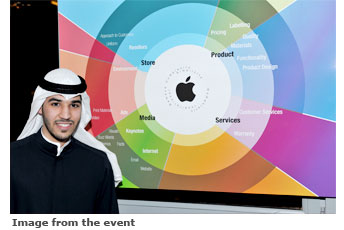
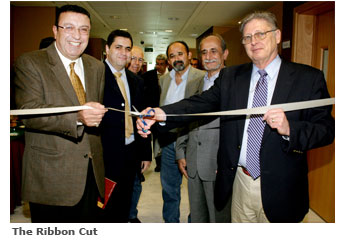
This semester GDES 490 was taught by Assistant Professor Marcella Kulchitsky who along with Campus Services organized the exhibit. According to Professor Kulchitsky, the Capstone course gives AUK students an opportunity to transform an idea or concept into a creative expression that communicates a message. She explains, "This is an important process that every graphic design student should experience before they enter the design market place."
Professor Kulchitsky also points out that AUK takes a different approach to learning the discipline of graphic design than vocationally oriented institutions. She explains, "vocationally oriented schools treat the design process as secondary to the student's learning and emphasize the end product. Consequently, students have flashy project but portfolios with very little substance." She continues, "At AUK we are committed to preparing our students to have the capacity to think before they begin the design process." According to Professor Kulchitsky this will make AUK students much better designers in the long run.
The exhibition was open to all AUK faculty and staff, as well as their families. The students exhibiting their work were:
Abdulaziz Al-Mudhaf
Danah Jbara
Ehab Mahran
Faisal Al-Mutawaa
Fatima Al-Sughayer
Fatma Jawhar
Jassem Al-Wazzan
Meshari Al-Muhaini
Mohammad Al-Aradi
Mohammad Al-Wuqayyan
Noor Makki
Othman Al-Othman
Shahed Al-Matrouk
Slaiman Anbar
Talal Al-Mutawaa.
Forty five AUK students participated in the three-day REUSE 4.0 exhibition at the Australian College of Kuwait (ACK). AUK Instructor Roma Soni encouraged her 'Introduction to Creativity' class to participate in the event this year to promote social responsibility and create a platform on which aspiring and creative artists can share their work. Zahed Sultan, CEO of env.earth and organizer of the event visited AUK and selected unique and creative artwork by AUK students to be displayed at REUSE 4.0.
REUSE 4.0, under the patronage of Sheikh Jaber Al-Mubarak Al-Hamad Al-Sabah, helped promote eco-friendly and sustainable living with more than 150 participants and ten modules and featured a variety of art galleries, music, film screenings, mixed media installations, go-kart races, trendy eco-fashion products and accessories, prizes, surprises and more.
The displayed artwork was primarily based on recycling and include such pieces as newspapers made into a designer sofa set and wall hanging by Lamia Al Salahi, 'Skully' by Dhari Al Qabandi, Yousef Al Ali and Abdullah Al Kandri, such as 'Capra' serpent made out of bottle caps by Dhari, a newspaper dress by Waroud Al Sabeeh, shell artifacts by Jassim Al Fadhli and Abdulaziz Al Haroon, eggshell chandelier by Fatma Jawhar and Hessa Malek, a table constructed with an old car engine base by Ahmad Al Ahmad and Abdullah Al Ramadhan, and other creatively recycled materials. Films like Jack Shaheen's Reel Bad Arabs were screened in order to introduce the audience to the world of racism and stereotypes in film.
The 'skull iPod' and the 'engine table' by AUK students received two of the three outstanding awards that were given away. AUK Instructor Roma Soni received an award for her commitment and undivided efforts in motivating students to create and participate.
Images from the Event
Released by the PR & Marketing Department on the 18th January 2011
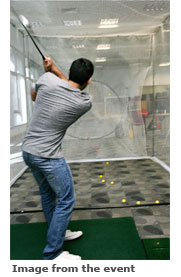
The Multi-Purpose Room was transformed into a Golf Academy. A virtual driving range system, chipping equipment, putting equipment, and golf instructors were all brought in to create a total golfing experience; all equipment and instructors were kindly loaned from Golf Me, the first pro golf shop in Kuwait.
AUK students, faculty, and staff were taught proper golfing technique and given the opportunity to practice driving, chipping, and putting. Each day of Golf Week offered a different competition, where participants could put their new found golf skills to the test. Competitions included Longest Drive, Closest to the Pin, Chipping, and Putting.
AUK is proud to recognize the following winners:
Longest Drive - Men's Champion
Faysel Muhammad - 297 yds
Longest Drive - Women's Champion
May Omran - 232 yds
Closest to the Pin - Men's Champion
Maher Dabbouseh - 5 ft
Closest to the Pin - Women's Champion
Marisa Tessier - 19 ft
Chipping Competition - Men's Champion
Fahad Alajeel - 34 pts
Chipping Competition - Women's Champion
Jenan Bu-Abbas - 34 pts
Putting Competition - Men's Champion
Mohammed Al-Sabti - 5 pts
Putting Competition - Women's Champion
Haneen Al-Ashqar - 3 pts.
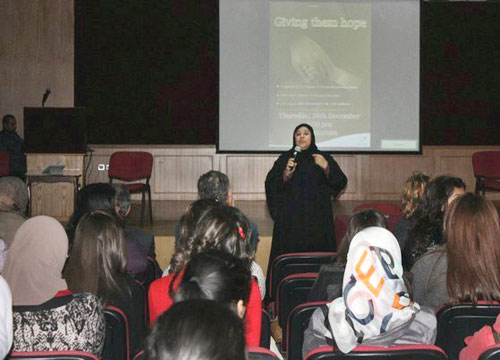
Hope Club is one of AUK's newest organizations meant to give students an overview of opportunities to do humanitarian work, and experience the rewards of service and the unique spirit of partnership. Their ultimate goal being that more and more AUK students participate in volunteer opportunities and be inspired by the ideas and events of the club as they contribute towards society. The participation of the students allowed them to delve into a world that wasn't their own, and understand the different ways that they could involve themselves in humanitarian.
Rana Abdel Hamid, the event's host, began by introducing the Club's President, Mohammad Abu-Mazen who gave a short speech saying, "We will do our best to put smiles on as many faces as we can."
Following Abu-Mazen's speech, Rana invited guest speaker Dr. Samia Al-Muttawa to present the audience with an inspiring speech in Arabic about the importance of volunteering. Dr. Al-Muttawa, who is currently involved in several projects aimed at helping those with no homes, and those who are unable to support themselves in getting an education, concluded her speech by explaining the importance of the projects and encouraged students to do some volunteer work by firstly involving themselves in the Hope Club.
A slideshow presentation followed highlighting some of the Club's activities including a visit to Sabah Hospital for Children. The club members interacted with the children who suffered from Leukemia. Bringing along toys and painting equipment, the members sat with the children for a few hours. The slide show offered the audience a glimpse into what kind of events and projects the Hope Club is in involved in.
The evening concluded with a play written by AUK Students Yousef Nayef, and Lujain Abu-Zaid. This play titled "Old Papers," told the story of an old man, whose children resorted to taking him to a nursing home. The story focused on how the man's life was changed by the volunteers who began assisting him in the nursing home and the importance of what they did. Directed by Hisham Wayem, the play cast Mennatallah A Abdul-Hamid, Razan Farhat, Mohammad Nedal, Ousamah Farra, and Sara Raji.
With the inauguration of the new Computer Engineering laboratories, the Computer Engineering program at AUK aspires to become one of the leading programs in the Gulf, offering Kuwait new entrepreneurs in the field of computer engineering, increasing the potential for advance research and development as well as creating a wealth of new opportunities for the economy as a whole. The computer engineering labs service several courses in the program including electric circuits, electronics, digital logic, computer organization and architecture, signals and systems, microprocessors and computer interfacing, embedded systems, among others.
Dr. Issam Damaj, Computer Engineering Program Lead at AUK and the designer and Project Manager of the new laboratories said, "AUK's Computer Engineering laboratories contain state-of-the-art devices and first-class furniture carefully designed to provide excellent teaching, learning, and undergraduate research environments. The lab designs adopted two different teaching styles to support module-based and component-level implementations. The laboratory equipment is supported by modern measurement devices. The implementation and experimentation processes are aided by world-class design software. The laboratory furniture designs are tailored to meet the need for storage space. The benches and other items are intended to combine ergonomic style, aesthetic sense, and advanced technology."
The Computer Engineering program at AUK focuses on providing students with intensive high-quality hands-on experiences. AUK has made a big investment in the preparation of these laboratories to support the program with premium teaching tools. Through this program, AUK aims to fulfill the requirement in Kuwait for a superior quality, technologically advanced and well rounded educational program that can compete with high quality North American universities. The Computer Engineering program is centered on the key principles of liberal arts and science while providing students with exposure and access to contemporary technology and applications.
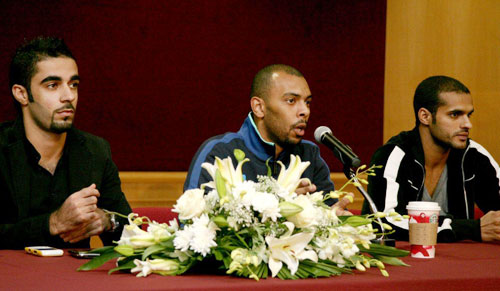
Students packed into the auditorium where they asked the players questions and took pictures with the Gulf Cup winners. The players expressed their happiness with this honoring and promised the students that they will aspire to do even better in the future. "This is the result of good coordination and cooperation between the team's administrators and players," said Al-Mutawa.
"I am happy to be with you here. This is only the beginning and expect better results in the future, especially with all of this support that we have from the Kuwaiti public," said Jarah Al-Ateeqi.
Hussein Fadhil said that he is proud of this win and it's a gift to the Kuwait public, while Yousef Nasser added that this victory wasn't about any one player, it was the result of great team work.
SGA President Khalid Al-Abdulghafour congratulated the national team for this historic win on behalf of SGA and the AUK student body.
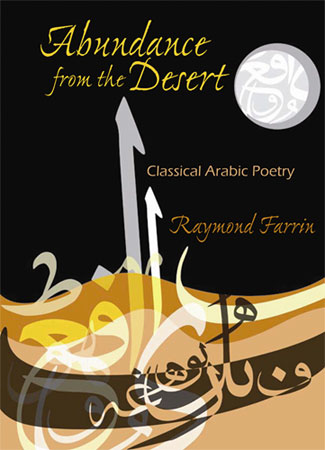
The book provides a comprehensive introduction to classical Arabic poetry covering the period roughly of 500-1250 CE. It features original translations and illuminating discussions of a number of major classical Arabic poems from a variety of genres. The poems are presented chronologically, each situated within a specific historical and literary context. Together, the selected poems suggest the range and depth of classical Arabic poetic expression; read in sequence, they suggest the gradual evolution of a tradition.
Moving beyond a mere chronicle, Dr. Farrin outlines a new approach to appreciating classical Arabic poetry based on an awareness of concentric symmetry, in which the poem's unity is viewed not as a linear progression but as an elaborate symmetrical plot. In doing so, the author presents these works in a broader, comparative light, revealing connections with other literatures. The reader is invited to examine these classical Arabic works not as isolated phenomena-notwithstanding their uniqueness and their association with a discrete tradition-but rather as part of a great multicultural heritage.