

News
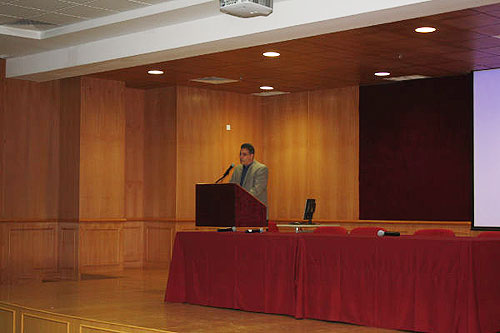
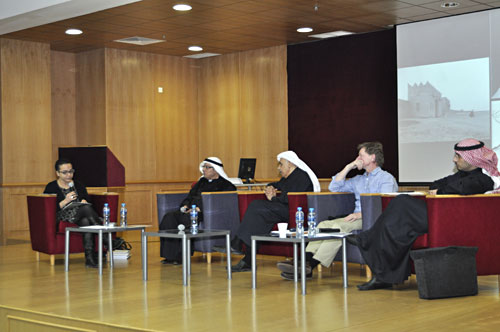
The Center for Gulf Studies (CGS) at the American University of Kuwait in cooperation with Arabana Project hosted a panel discussion entitled "Subbiya: Building Kuwait's Second City" to discuss the social and cultural dimensions associated with the development plan in the area of Subbiya. The discussion took place on Dec 20 and hosted a number of experts in architecture, archaeology, social geography, and tourism, to examine the various social and cultural aspects related to this project.
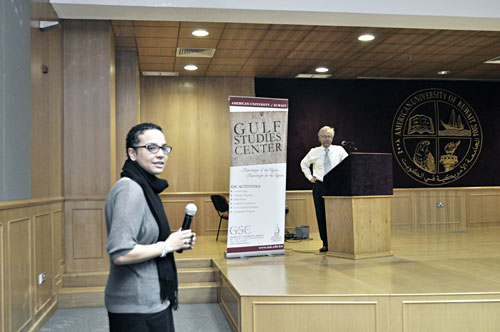
The discussion started with an introduction by Dr. Farah Al Nakib, the Director of the Center for Gulf Studies, about the Subbiya project and the proposed "Silk City" which the Kuwait Municipality is currently developing in cooperation with the private sector. Dr. Al Nakib pointed out that the Center for Gulf Studies wanted to raise awareness on significant national project, which unfortunately is not receiving enough media and public attention.
Dr. Derek Kennet, Senior Professor of Archeology at Durham University, who is conducting excavation work in Subbiya, commented on the historical aspects pertaining to area and the surrounding region. He described the rich archeological finds in Subbiya, which include among them some of the oldest representations of seafaring vessels ever found around the world. It was suggested that creating awareness of Subbiya's thriving past not only could contribute to developing a touristic aspect to the city, but could also help create identification with the area that was so successfully inhabited by Kuwait's ancient population.
As for the socio-geographic perspective of the project, Dr. Abdulrasool Al Mousa, Professor of Geography at Kuwait University, explained that the prospect of being removed from the congestion of the capital city might encourage Kuwaitis to look forward to the promising future of Subbiya. Although the new city would only be across a bridge passing over Kuwait Bay, the general idea of a new commercial, economic, recreational and residential city in itself makes it sound as though it is far and distant from the old city crowd. Dr. Al Mousa also raised several important questions on the issue, asking how Kuwaitis, the vast majority of whom work in the public sector, could be encouraged to relocate away from Kuwait City, and how the demographic nature of the new city would be managed.
In terms of tourism and recreation, Mr. Nabil Shashatari, the General Manager of Safir Hotels Group in Kuwait discussed the touristic aspect of the new city. He spoke about the Safir Heritage Village project in Failaka Island, which is a resort as well as an environmentally friendly village with many elements of attraction to the public and the tourists. He drew parallels between Failaka, as a local tourist destination, and the potential for Subbiya which could also have great touristic potential.
During the event, several panelists and audience members expressed their concern over whether the failures of city planning in Kuwait City would be repeated in Subbiya, such as the construction of large, expensive villas that are increasingly unaffordable to the local population. Dr. Nasser Abulhasan, co-founder of AGi Architects in Kuwait, stressed the importance of policymakers engaging the public on plans for Subbiya before taking any action. He warned that a lack of transparency in the planning stages could lead to a failure to meet the needs and desires of Kuwait's population. The audience, for their part, remained engaged throughout the discussion, with several young Kuwaitis asking how they could get involved in the decision-making process. While many expressed skepticism, Dr. Abulhasan urged the public to approach the issue with optimism, saying that if the population is proactive about expressing how they envision the future city, there is great potential in creating a thriving residential community in Subbiya.
This event is the first of three panel discussions to be co-hosted by the AUK Center for Gulf Studies and The Arabana Project that will address the various impacts and implications of Subbiya's development. The second panel discussion will focus on the environmental implications of building in Subbiya, and the third will examine the economic and geo-strategic aspects. They are planned for January and February 2012, respectively. The aim is to increase public awareness of, discussion on, and participation in the current planning process, and to critically analyze the various issues that are at stake on the human, environmental, and strategic levels.
The Center for Gulf Studies (CGS) at the American University of Kuwait is a research center that aims to promote greater cultural understanding of and increased intellectual interest in the Gulf by facilitating free and open academic discourse on a range of issues that both shape and challenge this critical region of the world. The goal of CGS is to enable scholars as well as political and civil society actors both within and outside the region to contribute and add value to the burgeoning field of Gulf Studies, while at the same time informing and engaging the general public. To this end, the CGS encourages, supports, and cultivates interesting and original research on the Gulf, while regularly organizing a variety of public academic events such as lectures, roundtable discussions, and conferences.
Released by the Office of Public Affairs on the 22nd December 2011
Photography by the Office of Public Affairs (C) 2011
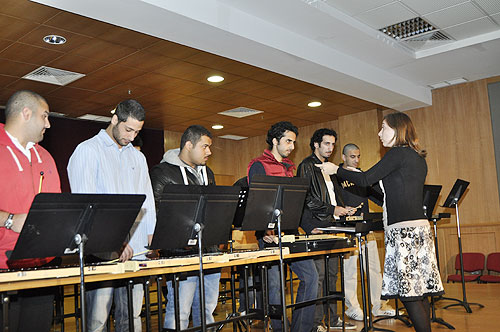
The Music Program at the American University of Kuwait (AUK) presented an informal concert of students from the beginning level music classes on Tuesday, Dec. 13, 2011.
The afternoon performances began with the Xylophone Ensembles, presented by Prof. Agnieszka Fajga. Especially notable was the more advanced group (MUSC 165) who impressed with their syncopated polyphonic segments and group skills in interpretations of works, such as the choral finale of Beethoven's 9th Symphony. Next, six small guitar groups performed offering charming renditions of classics, such as "Carol of the Bells" and "Country Gardens." A highlight was the female guitar trio with musicians Farnaz Heidari, Shorouq Al-Enizy, and Samantha Combs presenting the tango "Some King of Sunset."
The concert ended with featured voice students of Prof. Anna Karadimitrova and her two large ensembles-the female group singing a lovely 3-part version of "The Streets of London," and the males presenting a crowd pleasing, "You Raise Me Up." Dr. Lisa Urkevich, the Coordinator of the Music Program said, "This was a great opportunity for our less experienced music students. Most have never performed on a stage before, let alone in front of hundreds of their peers. All had good reason to be proud of their accomplishments that day."
Released by the Office of Public Affairs on the 19th December 2011
Photography by the Office of Public Affairs (C) 2011
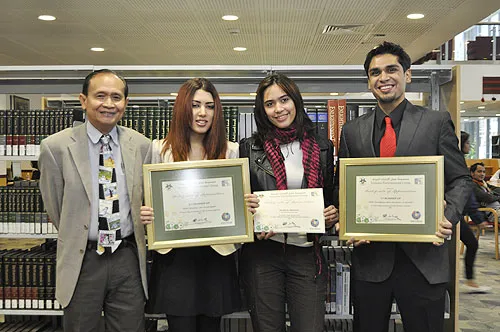
Two teams from the American University of Kuwait (AUK) competed in the 11th Environmental Speech Competition in Dubai winning 2nd and 3rd place. Coached by Professor Don Prade, Senior Instructor of English at AUK, Luke Rangel, assisted by Marie El Neaman, won 2nd place in the speech competition on "Development without Destruction: Is it Possible?", a category with 14 participating universities from the GCC countries. In the other competition on the topic, "Recycling: Does it really Matter?" our speaker Helene El Neaman, ably assisted by her sister, Marie El Neaman, won 3rd place. There were 12 universities entered in this category.
The Inter School Public Speaking Competition, which is organized by the Emirates Environmental Group (EEG) is the first and only of its kind in the GCC that brings together the public and private sectors as well as boys and girls on a common platform to discuss and debate environmental and sustainability issues. This year, the contestants debated and discussed the four topics. Each team participating in the event consisted of 5 members, 4 for the research and preparation and one who presented it.
The tournament, which attracted the participation of more than 50 universities from the GCC, had four categories which were all hotly contested. AUK however, emerged in the spotlight once again as the coach of Prince Sultan University in Saudi Arabia put it, "Every time we see the name AUK in the contest, we worry and expect a tough fight!"
The winning teams with their coach (from left): Prof. Don Prade, Helene El Neaman, Marie El Neaman, and Luke Rangel
Released by the Office of Public Affairs on the 15th December 2011
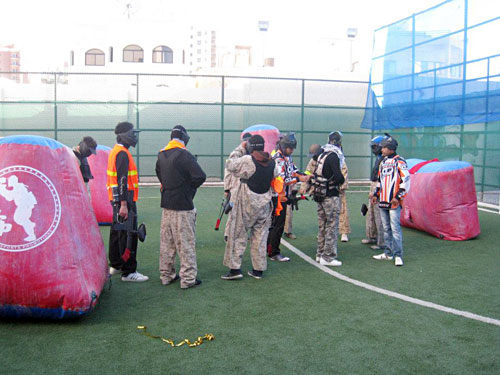
As part of Homecoming Week, AUK's soccer field was transformed into an obstacle ridden paintball war zone on December 6th. Organized by AUK Intramurals in association with Paintball Kuwait, the competition saw participants placed in teams of five and fitted with camouflage jumpsuits, masks, chest protectors, paintball guns and tongs of paintball ammo. Each team would compete against another team in a 20 minute game of capture the flag. Players would attempt to work as a team to shoot their opponents, protect their teammates, cross the entire field, and capture the other team's flag without getting shot.
The entire AUK Community had the opportunity to get involved in the action. Participants ranged from hardcore paintball enthusiasts to first-time paintballers. No matter their paintballing background, once they were out on the field they were all adrenaline full, paintball firing machines. AUK student, Omar Mehdi, commented on the event, "It was so much fun! I can't wait for AUK to do it again". This was the first time AUK has had a paintball event on campus and the Office of Student Life is already looking at having a paintball tournament in the not too distant future.
Released by the Office of Public Affairs on the 14th December 2011
Photography by the Office of Public Affairs (C) 2011
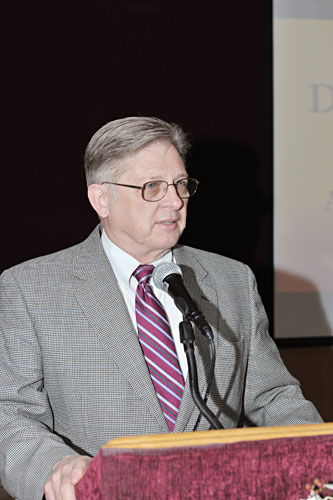
The Center for Gulf Studies at American University of Kuwait (AUK) hosted a talk by Dr. Nathan J. Brown, a distinguished scholar and author of several well-received books on Arab politics. The lecture took place on December 13 at the AUK Auditorium and attracted many AUK students, faculty, and external visitors and scholars.
During his lecture, Dr. Brown introduced his latest book When Victory is Not an Option: Islamist Movements in Arab Politics, which provides an analysis of Islamist movements in Kuwait, Egypt, Palestine, and Jordan. The lecture explored the prevalent themes in the book coming across the different Islamist movements currently gaining political power in the Arab world, and their implications on the future political scenery in the region.
According to Dr. Brown, Islamist movements, like the Muslim Brotherhood, had gone through ideological evolutionary phases changing from merely being socioreligious reform movements into political contestants. This evolution has put Islamist movements in what Dr. Brown called "the grey zone", where they had to dilute their Islamic speech to accommodate their new roles as political parties.
Taking the Muslim Brotherhood as an example, Dr. Brown discussed the effects of the politicization of Islamist movements on the organizational goals and plans of these movements. According to Dr. Brown, the Islamist movements can easily slip into the political mistake of "planning for next elections rather than planning for next generations" unless they handle this transformation wisely. He compared the Muslim Brotherhood model in Egypt to the Hamas Model in Palestine and the Nahda Model in Tunisia.
At the end of his lecture, Dr. Brown opened the floor for discussion where he received questions about how he foresees the future of the Arab Region in light of the new changes. Dr. Brown provided two scenarios for the future of Islamic trends. In his interpretation, the new Islamic experience will shape the public political inclinations towards a democratic state with Islamic dominance or an authoritarian state with more liberal and secular dominance.
Dr. Brown's book has been published in Arabic and is currently being translated into English. In addition to this book, he has also authored several books on Arab politics, including: Resuming Arab Palestine, (University of California Press, 2003), Constitutions in a Non-Constitutional World: Arab Basic Laws and Prospects for Accountable Government, (SUNY Press, 2001), The Rule of Law in the Arab World: Courts in Egypt and the Arab States of the Gulf (Cambridge University Press, 1997).
Dr. Brown received his Ph.D. and M.A. from Princeton University, and was previously a scholar in residence at the Middle East Institute. He is currently a Professor of Political Science and International Affairs at George Washington University. Dr. Brown has recently been a member of the International Advisory Committee on drafting the Palestinian constitution and consultant to the UNDP's program on governance in the Arab world.
The Center for Gulf Studies (CGS) at the American University of Kuwait is a research center that aims to promote greater cultural understanding of and increased intellectual interest in the Gulf by facilitating free and open academic discourse on a range of issues that both shape and challenge this critical region of the world. The goal of CGS is to enable scholars as well as political and civil society actors both within and outside the region to contribute and add value to the burgeoning field of Gulf Studies, while at the same time informing and engaging the general public. To this end, the CGS encourages, supports, and cultivates interesting and original research on the Gulf, while regularly organizing a variety of public academic events such as lectures, roundtable discussions, and conferences.
Released by the Office of Public Affairs on the 14th December 2011
Photography by the Office of Public Affairs (C) 2011
In celebration of AUK students' academic achievements for the Spring semester 2011, a ceremony was held at the Liberal Arts Auditorium where recipients of the President's Honor Roll and Dean's List shared their joy with faculty, staff and parents.
An unprecedented 38 students we awarded by AUK President Dr. Winfred Thompson for being on the President's Honor Roll, which requires students to maintain a 4.0 GPA to be eligible for this honor. The Dean's List saw 274 recipients awarded by the Dean of the College of Arts and Sciences, Dr. Nizar Hamzeh. These exemplary students must maintain a minimum 3.5 GPA.
Spring 2011 President's Honor Roll
| Rasha Abdelhadi Aya Abdulhamid Ahmed Abul Sundos Al Mutawa Zainab Al-Baksami Eman Al-Fadhli Radia Alfili Mejren Al-Hammadi Rasha Al-Jabi Faiyez Al-Mousharji Maryam Al-Naserallah Haya Al-Neama Nourah AlOmar Huda Al-Rashid Fatima Al-Sabah Alia Aref Fakheema Badri Dana Banddor Hiba Bazzi |
Nada Bedir Sanjida Chowdhury Amineh Eida Helene El Neaman Nada El-Badry Mariam El-Temtamy Fawaz Fakim Ascia Farraj Isha Haider Maasoumah Hussain Zienab Hussain Moneba Iqbal Manit Kaur Aya Khazaal Khalid Mohammad Ghanima Najem Mohammad Sharaf Sara Soliman Sanaa Turky |
Spring 2011 Dean's List
| Alaa Abd Al Jawad Sara Abdelaziz Rasha Abdelhadi Omnia Abdelhalim Rana Abdelhamid Aya Abdulhamid Mennatallah Abdulhamid Bassam Abdulibdeh Afnan Abdullah Kawthar Abdullah Shahad Abdullah Ismail Abu-Abdo Bader AbuAmarah Ahmed Abul Mariam Abulhasan Hanan Ahmad Haleema Ahmed Lama Ahmed Batool Akhand Hamad Al Hajri Sundos Al Mutawa Saleh Al Ojeiri Jumanah Al Refaei Talal Al Sager Abdulla Al Wohaib Hamad Al-Abdullah Manayer Al-Adwani Noora Al-Ahmad Sarah Al-Ajmi Marym Al-Akili Fajer Alali Bashaer Al-Ali Fahad Al-Anzi Makia Al-Arbash Nour Al-Ariss Bader Al-Asfoor Abdulaziz Al-Ateeqi Salah AlAwadhi Ali Al-Baghli Sarah Al-Baghli Foad Al-Bahar Sayed Mustafa AlBahbahani Zainab Al-Baksami Shaikha Al-Bassam Bibi Al-Behbehani Ayat Al-Bloushi Alaa Eddin Al-Chalabi Wadha Al-Dalama Reham Al-Dallal Bedoor Al-Fadhli Eman Al-Fadhli Farah Al-Fahad Sara Al-Faraj Radia Alfili Aisha Al-Fuwaires Nora AL-Ghanim Jad Al-Haffar Mejren Al-Hammadi Shahad Al-Harban Noor Al-Hirz Noura Al-Hulaibi Taiba Al-Humaidhi Wadha Al-Hunaidi Wafaa Al-Husaini Bashayer Al-Hussinan Reem Al-Huwaidi Ali Ali Farah Ali Monira Al-Ibrahim Rasha Al-Jabi Yousef Al-Jenai Manal Al-Jtaili Fayza Al-Kazemi Mohammed Al-Kazemi Fatima Al-Khalaf Shareefa Al-Khamees Marhab Al-Loghani Ghalia Al-Loughani Abdulkadir Al-Machhour Fatema Al-Matrouk Thamer Al-Mayyan Rahma Al-Mishwat Faiyez Al-Mousharji Rashed Al-Mousherji Shaha Al-Mufarrij Yousef Al-Muhana Fajer Al-Mulla Maisaa Al-Musalam Hadeel Al-Musallam Helal Al-Mutairi Theyab Al-Mutairi Assayel Al-Mutawa Dana Al-Muttar Roqia Al-Najar Maryam Al-Naserallah Lamis Al-Nazer Haya Al-Neama Razan Al-Obaid Dalal Al-Obaidly Rawan Al-Omani Nourah AlOmar Lolwa Al-Omar Dana Al-Otaibi Eissa Al-Qadeeri Khaled Al-Qahtani Ghaneema Al-Qudmani Ahmad Al-Raba Mona Al-Rashed Hashim Al-Rasheed Huda Al-Rashid Latifah Al-Saad Fatima Al-Sabah Haya Al-Sabah Lulwa Al-Sabah Salem Al-Salem Farah Al-Saqlawi Barrak Al-Sarraf Manar Al-Sarraf Sara Al-Sayed Bader Al-Sayed Ahmed Sarah Al-Serry Kholod Al-Shamry Mona Al-Sharrah Maryam Al-Shatti Shaima Al-Shukaili Hashim Al-Sughayer Fatma Al-Sumaiti Noura Al-Suwalem Razan Al-Tahan Bader Al-Tatawy Sara Al-Terkait Mohammad Al-Thafiri Dalal Al-Therban Saja Al-Therban Albaraa Al-Tourah Muneerah Al-Trad Khawlah Al-Tukhaim |
Fahad Al-Wadani Halima Al-Wazzan Hessah Al-Wazzan Reem Al-Wazzan Ahmad Al-Wuhaib Talal Al-Yaseen Najat Al-Yatama Reem Al-Yousef Alia Aref Aliaa Ashkanani Iman Askar Noha Assaad Ali Atesh Njoud Aweis Ramsey Awwad Fakheema Badri Dana Banddor Alaa Basha Lamiya Baz Hiba Bazzi Nada Bedir Amal Behbehani Anwar Behbehani Sepideh Behbehani Ahmed Ben Awadh Bader Bin Naji Zahra Bin Nakhi Shahad Bin Salamah Shahad Bin Salamah Dana Bin Salem Dalal Binsabtt Hanan Boqtosh Mariam BouGammaz Laura Boulos Marina Boulos Jassem Bourahmah Farah Bourislee Fudda Bujbara Alaa Buqammaz Sanjida Chowdhury Rand Dannan Amineh Eida Adnan Eidan Mashael Eissa Raghda El Deeb Helene El Neaman Noor El_Ali Nada El-Badry Halimah El-Husari Omar El-Khatib Mohammed El-Shafei Mohamed Elsharkawy Eman El-Taki Mariam El-Temtamy Fawaz Fakim Huda Farag Razan Farhat Ascia Farraj Sheikhah Fayez Michael Franicevic Carol Ghali Salma Ghali Reem Habib Isha Haider Amnah Hameed Dana Hani Meryem Hanna Katy Hauranieh Farnaz Heidari Syed Abrar Husain Elham Hussain Maasoumah Hussain Zienab Hussain Moneba Iqbal Dana Jaber Ahmad Jafar Fajer Jamal Kurian Joseph Jihan Kablaoui Abdullah Karimi Noor Kassem Manit Kaur Salli Khaddag May Khafash Bader Khalaf Stephanie Khalil Aya Khazaal Rayan Maghnie Ahmed Majdalawieh Ali Majed Fatma Mansour Monica Matta Fahad Mesalem Ali Mobasher Dalal Mohammad Khalid Mohammad Arwa Mulla Ali Abdulla Murad Jomana Mustafawi Ghanima Najem Dina Naser Riad Nasser Ali Nawab Dana Nusair Michele Pace Fatma Qatan Khaled Radwan Luke Rangel Mark Rangel Anam Rasheed Tasneem Rashwan Maher Rehayel Fatima Sakit Balqees Salem Dalia Salman Alaa Sarhan Walaa Shaheen Mohammad Sharaf Ayatallah Sharawi Fatemah Sheshtar Sara Soliman Majdi Suleiman Mariam Sultan Nourin Tajani Ali Taqi Sarah Thakur Maymoonah Toubeh Sanaa Turky Joshua Williams Fatma Yasin May Younes Abdulwahab Yousef Maha Yousef Ahmad Youssef Sally Zaghloul Khawla Zamani Zeinab Zeinab |
The American University of Kuwait (AUK) is an independent, private, equal opportunity, and co-educational liberal arts institution of higher education. The educational, cultural and administrative structure, methods and standards of AUK are based on the American model of higher learning. The language of instruction is English. More information on the American University of Kuwait can be found at www.auk.edu.kw.
Released by the Office of Public Affairs on the 12th December 2011
Photography by the Office of Public Affairs (C) 2011
The Arabic Literature Club at the American University of Kuwait hosted an Arabic poetry student competition and open discussion at the AUK Auditorium in the Salmiya campus. The main purpose of the competition was to encourage talented students to share their poems with the AUK community and experts of Arabic poetry. The competition was juried by Kuwait's prominent poet, Jenna Al-Greini; and Kuwait University Professor, Dr. Siham Al-Freih; along with AUK Arabic Professor and Program Lead of Arabic, Dr. Raymond Farrin.
During the event, which attracted a wide range of audience, the student contestants recited a number of poems from a variety of genres. All poems were authored by the students, conveying their self experience. As the young poets shared their deepest feelings through verse, the audience eagerly listened and responded.
Following the competition, Al-Greini took to the stage to recite some of her famous poems, captivating the audience with her unique style and literary abilities. An open discussion about Al-Greini's poetry was the finale of the poetry night. The event was then concluded by an awards ceremony announcing the winners and honoring all participants.
Professor Khaitam Al-Khouli, Assistant Professor of Arabic and Advisor of the Arabic Literature Club, commented on the event saying, "This event is fruitful, rich and reflects the existence of an effective group of our students who preach a successful future of the Arabic language and literature by authoring a variety of poems which reflect their emotional and self - experience in life."
The Arabic Literature Club at the American University of Kuwait, currently lead by Maryam Fadhl, is a student organization interested in different aspects of the Arabic language and culture such as Arabic poetry and literature. The main purpose of the Club is to reveal the Arab identity and practice Arabic language at AUK. Most of the club events currently focus on Arabic literature and poetry. The Arabic Club aims to host more cultural events that would include Arabic music and hosting of famous experts in the Arabic language to share their experience and thoughts with the students. All events hosted by the Arabic Club are being done in association with the Arabic Department at AUK.
The American University of Kuwait (AUK) is an independent, private, equal opportunity, and co-educational liberal arts institution of higher education. The educational, cultural and administrative structure, methods and standards of AUK are based on the American model of higher learning. The language of instruction is English. More information on the American University of Kuwait can be found at www.auk.edu.kw.
Released by the Office of Public Affairs on the 8th December 2011
Photography by the Office of Public Affairs (C) 2011
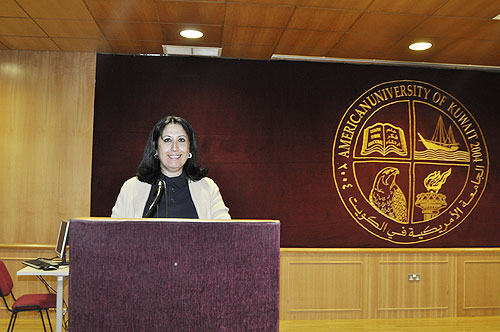
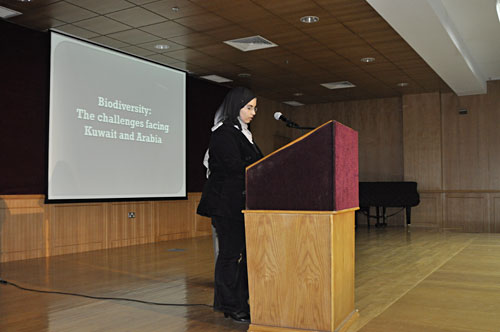
The Center for Gulf Studies at the American University of Kuwait (AUK) hosted a talk by Eng. Abdulrahman Al-Sirhan about Biodiversity in Kuwait and Arabia. The event took place at the AUK Auditorium and attracted many AUK students, staff and faculty.
Al-Sirhan focused on the importance of preserving the earth's biodiversity and biological wealth to human life and economic well-being. According to Al-Sirhan, many human activities are negatively affecting biodiversity and disturbing the ecosystem. In Kuwait, this phenomenon can be observed in overgrazing, housing expansion, and coastal development. These human practices have direct and indirect effects on the degradation and destruction of Kuwait's ecosystem. Al-Sirhan listed some examples of those possible ecological hazards including, changes in numbers and distribution of species, alteration of natural chemical cycles and energy flows, as well as pollution of air, water and soil.
Al-Sirhan also shed light on the regulatory perspective associated with Kuwait's ecological issues. He warned that inadequate implementation of policies that promote preservation of Kuwait's ecosystem will lead to severe damage, and eventually, the extinction of many species including those that are endemic to Kuwait's habitat. Furthermore, policies aimed at "making the desert green" could have disastrous effects.
Concluding his lecture, Al-Sirhan put forth some recommendations to support Kuwait's biodiversity. He stressed that instead of efforts to turn the desert green, policymakers should focus on preserving Kuwait's indigenous species, preventing overgrazing, and educating the public on the value of Kuwait's biodiversity.
Al-Sirhan holds a B.Sc. in Electrical Engineering from Manchester Polytechnic University, UK. His contributions to improving understanding of Kuwait's biodiversity include the publication of three scientific papers on Kuwait's reptiles, and the discovery of various species of plants, birds and reptiles within Kuwait. Al-Sirhan is also a co-opted council member of the Ornithological Society of the Middle East, and Secretary of the Kuwait Ornithological Rarities Committee. His website, www.alsirhan.com, includes a comprehensive list of all bird species that inhabit Kuwait.
The Center for Gulf Studies (CGS) at the American University of Kuwait is a research center that aims to promote greater cultural understanding of and increased intellectual interest in the Gulf by facilitating free and open academic discourse on a range of issues that both shape and challenge this critical region of the world. The goal of CGS is to enable scholars as well as political and civil society actors both within and outside the region to contribute and add value to the burgeoning field of Gulf Studies, while at the same time informing and engaging the general public. To this end, the CGS encourages, supports, and cultivates interesting and original research on the Gulf, while regularly organizing a variety of public academic events such as lectures, roundtable discussions, and conferences.
Al Akhdar Environmental Club, led by Rasha Abdelhamid, is a student organization that aims to implement schemes that enrich appreciation for the environment, demonstrating the link between environmental and social relations and enhancing environmental sustainability within Kuwait and the Arab Vicinity. Under the supervision of its Academic Advisors, Dr. Ali Al Jamal and Dr. Aly Mansour, Al Akhdar Environmental Club aspires to precede its reputation as a non-profit environmental organization and to become a leading figure in accordance to ecosystem conservation and ecology.
Released by the Office of Public Affairs on the 4th December 2011
Photography by the Office of Public Affairs (C) 2011
The American University of Kuwait announced the winners of the student competition for The President's Exhibition, Fall 2011. The winning art work was selected from the "best of the best" student class work from the previous semester, which was submitted to the competition by the AUK ART and Graphic Design (GDES) professors. The Exhibition includes painting, drawing, graphic design, cut paper, mixed media and photography work juried for creativity, originality, and technique. The 28 winners of the competition are:
-
-
-
Marhab Al-Loughani
-
Arwa Mulla Ali
-
Shahad Al Asfour
-
Aisha Al Jiran
-
Noura Anwar AlMansour
-
Helene El Neaman
-
Yousef Shaban
-
Farah Madi
-
Ahmed Al Turkait
-
Fatma Al-Tamimi
-
Sara Mohammed
-
Salwa S. Al-Qattan
-
Abdurrahman Al-Essa
-
Ramy Saboungui
-
Hassan Abdozzahraei
-
Fawaz Al-Yagout
-
Anwar Behbehani
-
Noura Al-Sharhan
-
Hessa Al-Enezi
-
Dalal Mohammad
-
Abdulaziz Yateem
-
Shahad A. Abdullah
-
Mishary Al-Munayes
-
Fatma Marafie
-
Jenan Al-Alban
-
Lamis M. Al-Nazer
-
Sarah Khalid Al-Bloshi
-
Sundes Al-Boloushi
-
-
Students with winning artwork received a certificate signed by AUK President Dr. Winfred Thompson; they and their parents were honored at a reception opening the exhibition. They will also enjoy having their work displayed in the President's office for the coming six months, which insures that their work will be viewed by dignitaries and other honored visitors to the University.
The AUK President's Exhibition is an excellent opportunity for students, as it works to increase student pride in execution, reward excellent work, and provide a valuable accomplishment on their resumes as they graduate and go out from AUK to graduate school or the workplace.
Professor Sharon Orleans Lawrence, Assistant Professor of Art History and Studio Arts is Chair of the AUK President's Exhibition; Professor Marcella Kulchitsky, Assistant Professor of Graphic Design, is Co-Chair.
The American University of Kuwait (AUK) is an independent, private, equal opportunity, and co-educational liberal arts institution of higher education. The educational, cultural and administrative structure, methods and standards of AUK are based on the American model of higher learning. The language of instruction is English. More information on the American University of Kuwait can be found at www.auk.edu.kw.
President Thompson with Exhibition Organizers Professor Marcella Kulchitsky and Professor Sharon Orleans Lawrence
Graphic Design majors Ramy Saboungui and Hassan A Abdolzzahraei, President Winfred Thompson, Professor Sharon Orleans Lawrence
Professor Sharon Orleans Lawrence, Farah Madi and Farah's mother
Graphic Design student Helene Neaman with her Monochromatic Study, Cut Color Theory Paper
A selection of art work from the Exhibition: (left to right) An oil painting by Marhab Al-Loughani; inked positive/negative studies from Hassan Abdolzzahraei and Hessa Al-Enezi; graphic design tryptich by Fawaz Al Yagout; inked positive/negative studies from Ramy Saboungui and Arwa Mulla Ali; pastel painting from Fatma Al-Tamimi, and (above) photography and mixed media from Art professors William Andersen and Dr. Antonia Stamos
Released by the Office of Public Affairs on the 1st December 2011

The Human Rights Club at the American University of Kuwait organized a discussion titled "Civil Engagement & Democracy" in the AUK Auditorium to explore the challenges and strategies for building greater citizen participation and social engagement in Kuwait. The speakers included Dr. Mohammad Al-Wuhaib, Professor of Philosophy at Kuwait University and the Director of the Kuwait Center for Activate Citizens, as well as Mr. Slobodan Milic, Deputy Director of the Gulf Program of the National Democratic Institute Regional Office in Dubai.
Dr. Al-Wuhaib began the discussion with a brief history of the formation of the modern Arab regional States. "In order to understand Kuwaiti civil societies towards democracy one must recall the history," he said. Dr. Al-Wuhaib explained the legacy of the Ottoman rule over the Arab world and the subsequent European colonial context that helped create the current dictatorships. According to Dr. Al-Wuhaib, the colonial legacy in particular left the Arab world struggling with many dualism such as secularism or sharia, tribal identity or national identity, democracy or authoritarianism. "People," he said, "end up doubting both value systems." He went on to discuss the current legal climate of civil associations in Kuwait. He said that as long as the state has the power to dissolve any association for any reason, the only associations that will develop are those that strictly support the status quo or religious institutions.
Mr. Slobodan Milic continued the discussion by speaking of possible strategies and solutions for building civil societies and enhancing democratic participation from examples drawn from different parts of the world. Mr. Milic first stated that from world history "democracy means different things to different people." He noted that some of the most repressive autocracies such as the former USSR, Hitler's Germany, Pol Pot's Cambodia, and the Bosnian militias have all called themselves democratic. Drawing from the ancient Greeks Mr. Milic defined Democratic society as "one where the citizens monitor, assess, intervene, and reorganize the system of power." He argued that citizens should take an active role within civil society to make sure that people in power don't fall into their "natural behavior" to monopolize resources and decision making. Mr. Milic emphasized the importance of women in political participation and that empowering women as political candidates should be a priority to building civil societies.
The Human Rights Club at the American University of Kuwait is a student organization that seeks to spread awareness about democracy and human rights.
The American University of Kuwait (AUK) is an independent, private, equal opportunity, and co-educational liberal arts institution of higher education. The educational, cultural and administrative structure, methods and standards of AUK are based on the American model of higher learning. The language of instruction is English. More information on the American University of Kuwait can be found at www.auk.edu.kw.
Released by the Office of Public Affairs on the 30th November 2011