

The Center for Gulf Studies at AUK Hosts Lecture on Islamist Movements in Arab Politics
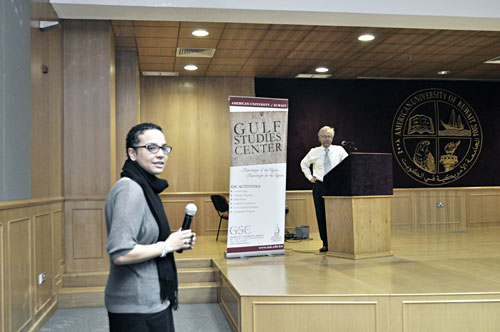
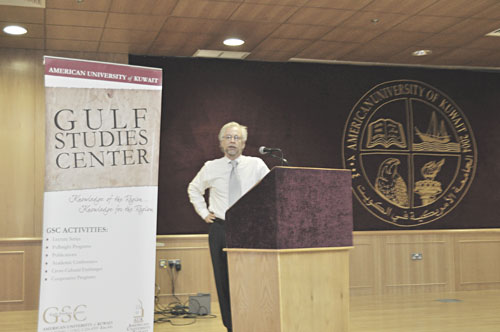
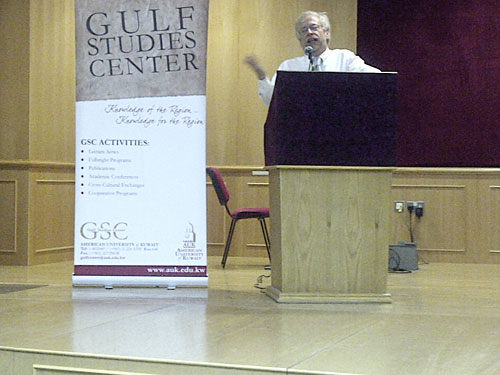
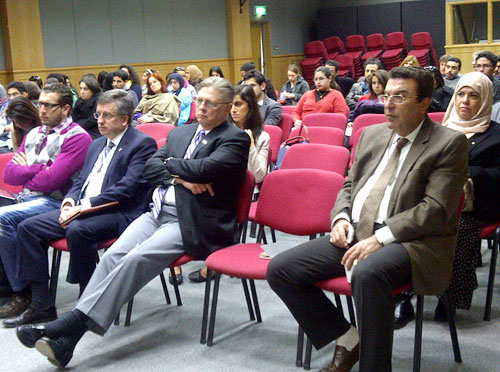
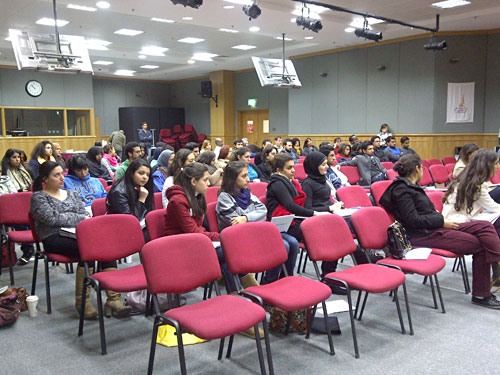
The Center for Gulf Studies at American University of Kuwait (AUK) hosted a talk by Dr. Nathan J. Brown, a distinguished scholar and author of several well-received books on Arab politics. The lecture took place on December 13 at the AUK Auditorium and attracted many AUK students, faculty, and external visitors and scholars.
During his lecture, Dr. Brown introduced his latest book When Victory is Not an Option: Islamist Movements in Arab Politics, which provides an analysis of Islamist movements in Kuwait, Egypt, Palestine, and Jordan. The lecture explored the prevalent themes in the book coming across the different Islamist movements currently gaining political power in the Arab world, and their implications on the future political scenery in the region.
According to Dr. Brown, Islamist movements, like the Muslim Brotherhood, had gone through ideological evolutionary phases changing from merely being socioreligious reform movements into political contestants. This evolution has put Islamist movements in what Dr. Brown called "the grey zone", where they had to dilute their Islamic speech to accommodate their new roles as political parties.
Taking the Muslim Brotherhood as an example, Dr. Brown discussed the effects of the politicization of Islamist movements on the organizational goals and plans of these movements. According to Dr. Brown, the Islamist movements can easily slip into the political mistake of "planning for next elections rather than planning for next generations" unless they handle this transformation wisely. He compared the Muslim Brotherhood model in Egypt to the Hamas Model in Palestine and the Nahda Model in Tunisia.
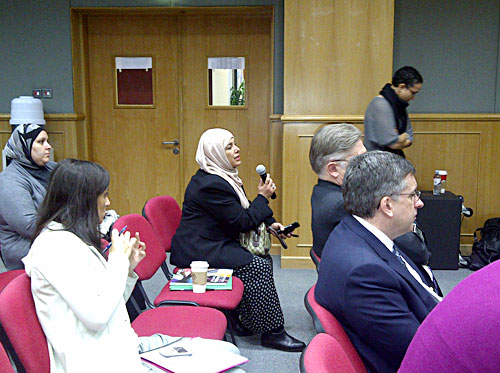
At the end of his lecture, Dr. Brown opened the floor for discussion where he received questions about how he foresees the future of the Arab Region in light of the new changes. Dr. Brown provided two scenarios for the future of Islamic trends. In his interpretation, the new Islamic experience will shape the public political inclinations towards a democratic state with Islamic dominance or an authoritarian state with more liberal and secular dominance.
Dr. Brown's book has been published in Arabic and is currently being translated into English. In addition to this book, he has also authored several books on Arab politics, including: Resuming Arab Palestine, (University of California Press, 2003), Constitutions in a Non-Constitutional World: Arab Basic Laws and Prospects for Accountable Government, (SUNY Press, 2001), The Rule of Law in the Arab World: Courts in Egypt and the Arab States of the Gulf (Cambridge University Press, 1997).
Dr. Brown received his Ph.D. and M.A. from Princeton University, and was previously a scholar in residence at the Middle East Institute. He is currently a Professor of Political Science and International Affairs at George Washington University. Dr. Brown has recently been a member of the International Advisory Committee on drafting the Palestinian constitution and consultant to the UNDP's program on governance in the Arab world.
The Center for Gulf Studies (CGS) at the American University of Kuwait is a research center that aims to promote greater cultural understanding of and increased intellectual interest in the Gulf by facilitating free and open academic discourse on a range of issues that both shape and challenge this critical region of the world. The goal of CGS is to enable scholars as well as political and civil society actors both within and outside the region to contribute and add value to the burgeoning field of Gulf Studies, while at the same time informing and engaging the general public. To this end, the CGS encourages, supports, and cultivates interesting and original research on the Gulf, while regularly organizing a variety of public academic events such as lectures, roundtable discussions, and conferences.
Released by the Office of Public Affairs on the 14th December 2011
Photography by the Office of Public Affairs (C) 2011
Related News