

News
28, Jun 2009
MUNAUK Visits Saudi Arabian and Omani Ambassadors
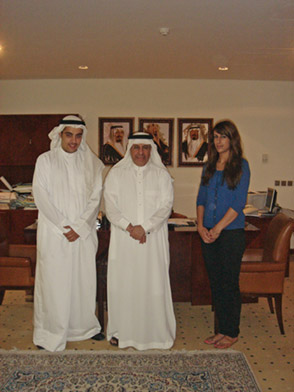
Among the endeavors that MUNAUK seeks to accomplish as an organization that fosters diplomacy in its members, visiting ambassadors to Kuwait is a crucial aspect of attaining expertise in the field of international relations. Many members of the Model United Nations Organization aspire to follow in the footsteps of Ambassadors. On that note, the Model United Nations Club at AUK had the privilege of meeting two ambassadors this past month. MUNAUK's Executive Committee, represented by the President Abdulaziz Safi Al-Mutawa and Vice-President Norah Al-Hilaly, were invited by the Ambassadors of Saudi Arabia and Oman to meet their Excellencies at their respective embassies. Their hospitality was overwhelming and truly represents the Arabian Gulf spirit of generosity.
His Excellency Dr. Abdulaziz Al-Fayez, the Saudi Arabian Ambassador, was very open to answering questions from the MUNAUK representatives. When asked about his experience working in Kuwait, the Ambassador said that he was very privileged to be working here because it is akin to working amongst family (being in the Gulf region). He stated that there are good relations within the Gulf region which is why not many difficulties arise. When asked about his job experience and whether he faced any barriers or difficulties as an Ambassador, His Excellency said that no job is convenient but being an Ambassador is definitely an enjoyable experience, adding that it is an opportunity to represent one's country and an ambassador would have to do so in the best possible manner. He stated that what helps his job being Ambassador in Kuwait is being close to Saudi Arabia. Without a doubt, he would have to check with his home government for some issues being so close to it truly helps with certain issues. Finally, the Saudi Arabian Ambassador was formally invited to the American University of Kuwait to speak, as an Ambassador, on his experience to AUK students.
MUNAUK is planning an event for the Fall where several Ambassadors to Kuwait may have the opportunity to speak to students at the American University of Kuwait regarding their experience as a diplomat. This will provide an opportunity to young adults wishing to learn more about representing one's country, policies, and issues.
President Abdulaziz and Vice President Norah also visited His Excellency, Sheikh Salem Suhail Al-Maashani, the Omani Ambassador. The Ambassador also agreed to participate and speak at an MUNAUK event. His Excellency reinforced the idea that the Gulf Countries have strong ties with one another and that the international relations between them is based on mutual respect, understanding, and a shared tradition and culture. When asked about his experience as an Ambassador, His Excellency Sheikh Al-Maashani surprisingly stated that he never thought he would become one. He said that circumstances change throughout life and it is always possible that we are presented with amazing opportunities. The Omani Ambassador considers himself fortunate to be working in Kuwait since there is a sense of closeness and good relations between Oman and Kuwait.
His Excellency Dr. Abdulaziz Al-Fayez, the Saudi Arabian Ambassador, was very open to answering questions from the MUNAUK representatives. When asked about his experience working in Kuwait, the Ambassador said that he was very privileged to be working here because it is akin to working amongst family (being in the Gulf region). He stated that there are good relations within the Gulf region which is why not many difficulties arise. When asked about his job experience and whether he faced any barriers or difficulties as an Ambassador, His Excellency said that no job is convenient but being an Ambassador is definitely an enjoyable experience, adding that it is an opportunity to represent one's country and an ambassador would have to do so in the best possible manner. He stated that what helps his job being Ambassador in Kuwait is being close to Saudi Arabia. Without a doubt, he would have to check with his home government for some issues being so close to it truly helps with certain issues. Finally, the Saudi Arabian Ambassador was formally invited to the American University of Kuwait to speak, as an Ambassador, on his experience to AUK students.
MUNAUK is planning an event for the Fall where several Ambassadors to Kuwait may have the opportunity to speak to students at the American University of Kuwait regarding their experience as a diplomat. This will provide an opportunity to young adults wishing to learn more about representing one's country, policies, and issues.
President Abdulaziz and Vice President Norah also visited His Excellency, Sheikh Salem Suhail Al-Maashani, the Omani Ambassador. The Ambassador also agreed to participate and speak at an MUNAUK event. His Excellency reinforced the idea that the Gulf Countries have strong ties with one another and that the international relations between them is based on mutual respect, understanding, and a shared tradition and culture. When asked about his experience as an Ambassador, His Excellency Sheikh Al-Maashani surprisingly stated that he never thought he would become one. He said that circumstances change throughout life and it is always possible that we are presented with amazing opportunities. The Omani Ambassador considers himself fortunate to be working in Kuwait since there is a sense of closeness and good relations between Oman and Kuwait.
MUNAUK President Abdulaziz Al-Mutawa with His Excellency Dr. Abdulaziz Al-Fayez, the Saudi Arabian Ambassador
MUNAUK President Abdulaziz Al-Mutawa with Omani Ambassador His Excellency Sheikh Salem Suhail Al-Maashani
18, Jun 2009
AUK Graduation Ceremony 2009
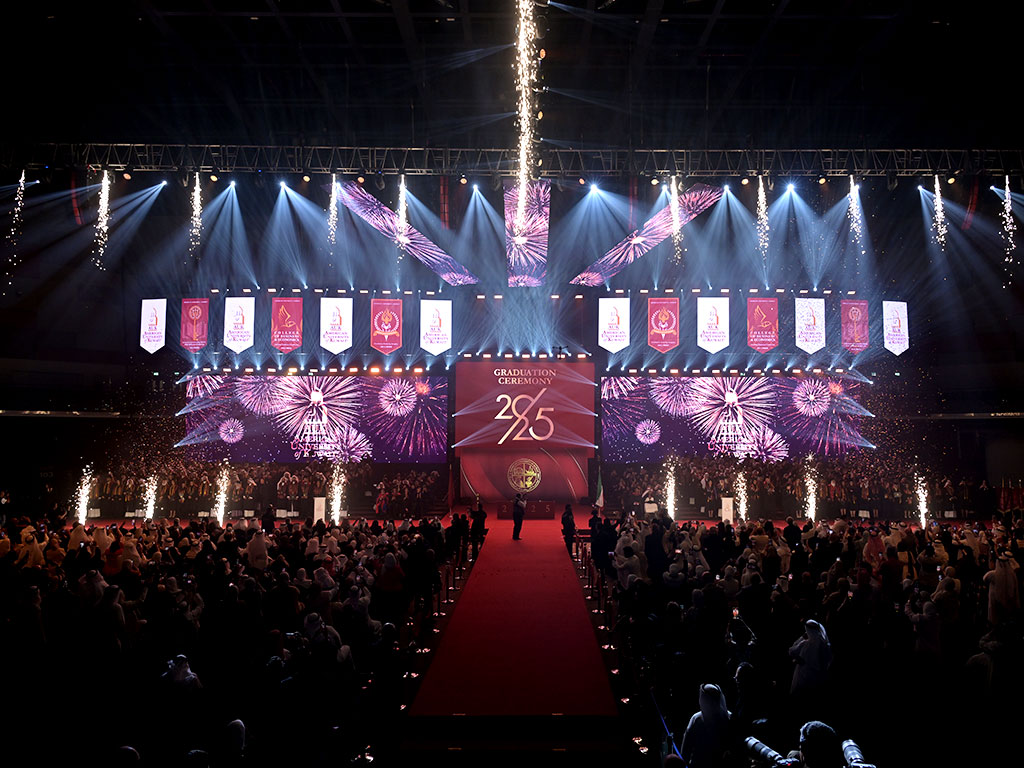
Mishref, Kuwait, June 18, 2009: The Graduation Ceremony of the Class of 2009 at the American University of Kuwait (AUK) took place at Kuwait International Fairgrounds (KIF) at 7 PM on Thursday, June 18, and saw 266 students graduate, under the patronage of His Excellency, former Oil Minister, Sheikh Saud Al-Nasir Al-Sabah, who was also the keynote speaker.
The ceremony commenced with the Kuwaiti national anthem and a recitation of the Holy Quran followed by a speech by Dr. Nizar Hamzeh, Dean of the College of Arts and Sciences who welcomed students, their families and guests to the ceremony. President of the University, Dr. Marina Tolmacheva then stepped to the podium and spoke about the graduating class and their many achievements. She said, "Under the tutelage of the AUK faculty, these seniors have mastered the knowledge of their field, the ability to think critically, the art of effective communication, and the respect for diversity, be that diversity national, ethnic, cultural, or intellectual. Our students have distinguished themselves in and outside the classroom." President Marina also read a congratulatory message from Dartmouth to AUK's graduating class saying, "Dartmouth congratulates you on your many accomplishments. As you graduate from AUK, remember that you have played a large role in shaping this community. You take that community with you. It will always be a part of your lives, as you will always be part of AUK."
AUK and Dartmouth College in Hanover, New Hampshire (USA), have worked closely together since 2003, when the two institutions signed a Memorandum of Understanding that facilitated a series of advisory, consultative, and cooperative projects. That initial agreement was renewed in June 2008 to extend through 2013.
The President then introduced the keynote speaker Sheikh Saud Al-Nasir Al-Sabah, a former Ambassador to Great Britain and the United States and former Oil Minister, who happens to be the father of one of AUK's adjunct faculty members and also the father of one of this year's graduates. He began by reminding the graduates of how lucky they are to not have to travel thousands of miles for a good quality American education. He then asked the graduates to "Remember one thing, you have your whole life ahead of you, the hard work is behind you, choose your life the way you want it." Sheikh Saud continued by encouraging students to head to the private sector where, he says, the challenge is. On a lighter note, Sheikh Saud commented on the topic of segregation in universities by saying, "I am happy to see a non-segregated union of our students," adding that this is the only proper way of preparing graduates for the real world. Sheikh Saud ended his speech by reminding the graduates of how proud of them he is.
Each graduate was then presented with her or his bachelor's degree diploma by Dr. Tolmacheva and Sheikh Saud Al-Nasir Al-Sabah, and Dr. Nizar Hamzeh- Dean of College of Arts and Sciences.
Dean of the College of Arts and Sciences Dr. Nizar Hamzeh and President Marina Tolmacheva then conferred upon the graduates their respective degrees, and in keeping with the academic tradition, the graduates were asked to move their tassels from right to left, thereby marking their official graduation from AUK.
Class of 2009 Valedictorian, Dina El-Zohairy, rose to the podium to deliver her speech, which was both inspiring and encouraging. "As hard as it is to leave our comfort zone, we have reached a turning point in our lives at which we need to pause and consider our role beyond AUK, as model citizens of the world and agents of change in our societies,"she said. "Think not of the degree you have earned as a ticket to self-motivated goals, but as a ticket of opportunity to make a difference in the lives of the people around you, especially given the tough times in which we are graduating."
Dina is graduating with a BBA degree in Management, and has earned the highest cumulative grade point average of this graduating class. A month ago, she joined AUK's Student Affairs crew as a full-time employee in the Office of the Registrar. Dina has been an active member of The Voice of AUK, worked as a student employee in the Office of Admissions and Center for Continuing Education and teamed up with Dr. Mourad Dakhli on a paper presented at AUK's 4th Liberal Arts Conference. Dina also did freelance work in writing and translation for Dar al-Tarjama and the Canadian Commercial Circle of Kuwait.
Following Dina's speech, another student, Shoug Al-Othman gave a motivational speech whereby she encouraged her fellow graduates to have faith in themselves and their abilities and to "Set aside your fear of losing and work with your dreams and ambitions as they will guide you towards achieving your goals."
The end of the ceremony was marked by the traditional cutting of the Class of 2009 cake in the reception area of the Hall, and professional photography was provided for all graduates and their families and friends.
The ceremony commenced with the Kuwaiti national anthem and a recitation of the Holy Quran followed by a speech by Dr. Nizar Hamzeh, Dean of the College of Arts and Sciences who welcomed students, their families and guests to the ceremony. President of the University, Dr. Marina Tolmacheva then stepped to the podium and spoke about the graduating class and their many achievements. She said, "Under the tutelage of the AUK faculty, these seniors have mastered the knowledge of their field, the ability to think critically, the art of effective communication, and the respect for diversity, be that diversity national, ethnic, cultural, or intellectual. Our students have distinguished themselves in and outside the classroom." President Marina also read a congratulatory message from Dartmouth to AUK's graduating class saying, "Dartmouth congratulates you on your many accomplishments. As you graduate from AUK, remember that you have played a large role in shaping this community. You take that community with you. It will always be a part of your lives, as you will always be part of AUK."
AUK and Dartmouth College in Hanover, New Hampshire (USA), have worked closely together since 2003, when the two institutions signed a Memorandum of Understanding that facilitated a series of advisory, consultative, and cooperative projects. That initial agreement was renewed in June 2008 to extend through 2013.
The President then introduced the keynote speaker Sheikh Saud Al-Nasir Al-Sabah, a former Ambassador to Great Britain and the United States and former Oil Minister, who happens to be the father of one of AUK's adjunct faculty members and also the father of one of this year's graduates. He began by reminding the graduates of how lucky they are to not have to travel thousands of miles for a good quality American education. He then asked the graduates to "Remember one thing, you have your whole life ahead of you, the hard work is behind you, choose your life the way you want it." Sheikh Saud continued by encouraging students to head to the private sector where, he says, the challenge is. On a lighter note, Sheikh Saud commented on the topic of segregation in universities by saying, "I am happy to see a non-segregated union of our students," adding that this is the only proper way of preparing graduates for the real world. Sheikh Saud ended his speech by reminding the graduates of how proud of them he is.
Each graduate was then presented with her or his bachelor's degree diploma by Dr. Tolmacheva and Sheikh Saud Al-Nasir Al-Sabah, and Dr. Nizar Hamzeh- Dean of College of Arts and Sciences.
Dean of the College of Arts and Sciences Dr. Nizar Hamzeh and President Marina Tolmacheva then conferred upon the graduates their respective degrees, and in keeping with the academic tradition, the graduates were asked to move their tassels from right to left, thereby marking their official graduation from AUK.
Class of 2009 Valedictorian, Dina El-Zohairy, rose to the podium to deliver her speech, which was both inspiring and encouraging. "As hard as it is to leave our comfort zone, we have reached a turning point in our lives at which we need to pause and consider our role beyond AUK, as model citizens of the world and agents of change in our societies,"she said. "Think not of the degree you have earned as a ticket to self-motivated goals, but as a ticket of opportunity to make a difference in the lives of the people around you, especially given the tough times in which we are graduating."
Dina is graduating with a BBA degree in Management, and has earned the highest cumulative grade point average of this graduating class. A month ago, she joined AUK's Student Affairs crew as a full-time employee in the Office of the Registrar. Dina has been an active member of The Voice of AUK, worked as a student employee in the Office of Admissions and Center for Continuing Education and teamed up with Dr. Mourad Dakhli on a paper presented at AUK's 4th Liberal Arts Conference. Dina also did freelance work in writing and translation for Dar al-Tarjama and the Canadian Commercial Circle of Kuwait.
Following Dina's speech, another student, Shoug Al-Othman gave a motivational speech whereby she encouraged her fellow graduates to have faith in themselves and their abilities and to "Set aside your fear of losing and work with your dreams and ambitions as they will guide you towards achieving your goals."
The end of the ceremony was marked by the traditional cutting of the Class of 2009 cake in the reception area of the Hall, and professional photography was provided for all graduates and their families and friends.
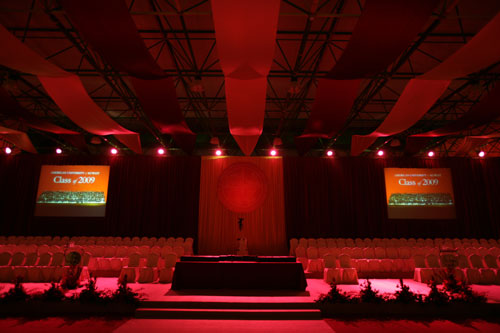
A view of hall 8 where the AUK graduation cermony took place
Sarah Boodai welcomes AUK guests before the beginning of the ceremony
The processional led by AUK faculty
Left to right: Sheikh abdala Salem Sabah Al Salem Al Sabah, Sheikha Dana Nasser Sabah Al-Ahmed Al-Sabah and US Ambassador Deborah Jones
A recitation of the Holy Quran by Abdulrahman Al-Farhan
The president of the American University of Kuwait Dr. Marina Tolmacheva
His Excellency, former Oil Minister& the keynote speaker, Sheikh Saud Al-Nasir Al-Sabah
Dean of the College of Arts and Sciences Dr. Nizar Hamzeh
Dean of Student Affairs, Dr. Carol Ross
Moving the tassels from right to left
Class of 2009 Valedictorian, Dina El-Zohairy
Shoug Al-Othman, motivational speaker
Sheikh abdala Salem Sabah Al Salem Al Sabah, Sheikha Dana Nasser Sabah Al-Ahmed Al-Sabah with Shoug Al-Othman & her family
The traditional cutting of the Class of 2009 cake
Portraits of graduates, their families & friends
Showing
10 Articles
of 1528
07, Jun 2009
Julius Caesar Visits AUK
AUK's Theater Program presented on May 27th-30th the famous play of William Shakespeare, Julius Caesar at the Black Box Studio, featuring for the first time a cast that included AUK faculty members.
Accounting Professor Jeremy Cripps starred as Julius Caesar and Margaret Combs, Director of the Intensive English Program, starred as Calpurnia, Rawda Awwad, had roles as Murella and Popilius Lena. Other faculty members include Raymond Farrin, Professor of Arabic and Christopher Ohan, Professor of History.
Professor Christopher Gottschalk, head of the Theater Program, directed the play and commented that on a daily basis he learns from his students as much as they learn from his teaching and that this was especially true with producing Julius Caesar.
Julius Caesar portrays the conspiracy against the famous Roman emperor of the same name and touches important themes such patriotism, loyalty and friendship.
Accounting Professor Jeremy Cripps starred as Julius Caesar and Margaret Combs, Director of the Intensive English Program, starred as Calpurnia, Rawda Awwad, had roles as Murella and Popilius Lena. Other faculty members include Raymond Farrin, Professor of Arabic and Christopher Ohan, Professor of History.
Professor Christopher Gottschalk, head of the Theater Program, directed the play and commented that on a daily basis he learns from his students as much as they learn from his teaching and that this was especially true with producing Julius Caesar.
Julius Caesar portrays the conspiracy against the famous Roman emperor of the same name and touches important themes such patriotism, loyalty and friendship.
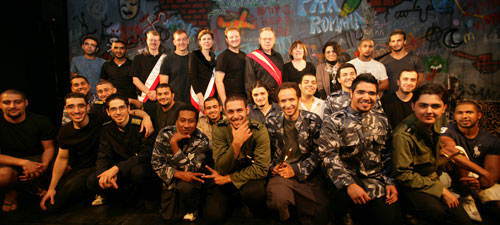
The cast of the play
Images from the play
03, Jun 2009
AUK Students Explore Bahraini Culture
Last week, a class of senior students of the American University of Kuwait (AUK) visited the land of two seas to gain a better understanding of Gulf regional culture. Under the patronage of the Minister of Culture and Information of Bahrain, Shiekha Mai Bint Mohammed Al-Khalifa, the students were immersed in Bahraini history, music, art, and heritage-site visits.
The students were impressed by the vastness of Bahraini history that dates back thousands of years, as well as by the quality of the national exhibits, especially the remarkable United Nations World Heritage site of the Bahrain Fort. Sherifa Al-Sabah, a graduating senior said, "It is wonderful, the way that Bahrain is putting effort into preserving their ancient heritage despite globalization."
The students were also delighted with the existing traditions of Bahrain, as they ate traditional food, interviewed and watched performances of folk musicians, and visited Bahraini dar (meeting places) that, although hundreds of years old, were still alive with activity. "It was a phenomenal experience," said Manwa Al-Yaqoub, a Communication and Media major. "We met people and saw things that I never would have imagined."
Dr. Lisa Urkevich, Director of the Arabian Heritage Project, a new research and outreach center at AUK, led the class of young scholars. Dr. Urkevich believes that gaining a better understanding of neighboring Gulf cultures will help Kuwaiti students better appreciate Kuwaiti heritage and place it into a regional perspective. "I think this research trip made the students realize that, although Kuwait and Bahrain have a great deal in common, the intricacies of the cultures vary tremendously," said Dr. Urkevich. "Of course, we were amazed by the effort and distinction that Bahrain has put into its cultural centers, and touched by the kindness of the Bahraini people and the pride they have for their heritage. However, our visit also helped us to reflect on Kuwaiti culture and opened dialog on how Kuwaiti heritage also plays and can play a special role in the Gulf."
The students were impressed by the vastness of Bahraini history that dates back thousands of years, as well as by the quality of the national exhibits, especially the remarkable United Nations World Heritage site of the Bahrain Fort. Sherifa Al-Sabah, a graduating senior said, "It is wonderful, the way that Bahrain is putting effort into preserving their ancient heritage despite globalization."
The students were also delighted with the existing traditions of Bahrain, as they ate traditional food, interviewed and watched performances of folk musicians, and visited Bahraini dar (meeting places) that, although hundreds of years old, were still alive with activity. "It was a phenomenal experience," said Manwa Al-Yaqoub, a Communication and Media major. "We met people and saw things that I never would have imagined."
Dr. Lisa Urkevich, Director of the Arabian Heritage Project, a new research and outreach center at AUK, led the class of young scholars. Dr. Urkevich believes that gaining a better understanding of neighboring Gulf cultures will help Kuwaiti students better appreciate Kuwaiti heritage and place it into a regional perspective. "I think this research trip made the students realize that, although Kuwait and Bahrain have a great deal in common, the intricacies of the cultures vary tremendously," said Dr. Urkevich. "Of course, we were amazed by the effort and distinction that Bahrain has put into its cultural centers, and touched by the kindness of the Bahraini people and the pride they have for their heritage. However, our visit also helped us to reflect on Kuwaiti culture and opened dialog on how Kuwaiti heritage also plays and can play a special role in the Gulf."
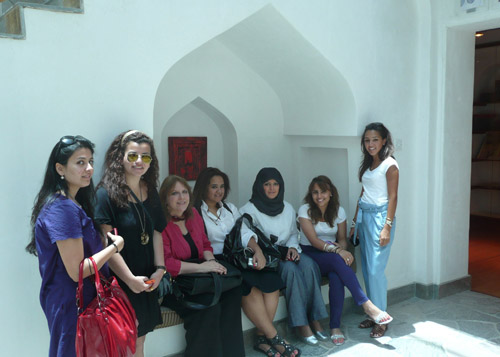
(from left to right) Noura Al-Shaya, Manwa Al-Yaqoub, Dr. Lisa Urkevich, Sherifa Al-Sabah, Nouf Al-Rashidi, Alyaa Al-Nafisi, Farah J Zainal
Juma Al Juma, Bahraini musician
03, Jun 2009
Gulf Studies Program at AUK Awards Second Certificate
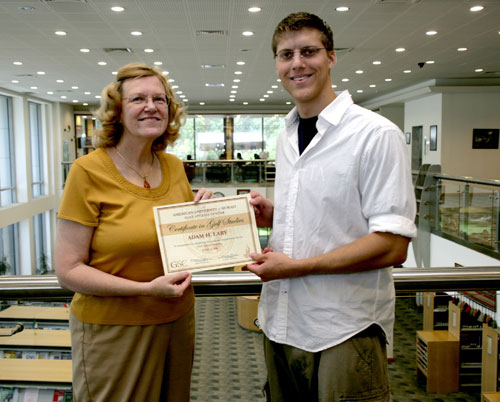
Adam H. Lary became the second student to receive a certificate from the Gulf Studies Program at the American University of Kuwait, coordinated by Dr. Marjorie Kelly, Assistant Professor of Anthropology. Lary is a West Point cadet who will be returning to the U.S. in early June to complete his B.A. in Engineering Psychology. While spending the Spring semester at AUK, he took courses in history, international relations, and anthropology as well as beginning the study of Arabic. He also enjoyed meeting Kuwaiti students and traveling locally to learn firsthand about Arab culture and history.
The Gulf Studies Certificate Program is designed for visiting students or non-degree-seeking students who wish to spend a semester at AUK, focusing on regional history, politics, society, culture, and the arts. Students are required to take a total of twelve hours from a growing list of courses that includes Islamic Art, the History of Kuwait, and Arab Society and Culture.
The Gulf Studies Certificate Program is designed for visiting students or non-degree-seeking students who wish to spend a semester at AUK, focusing on regional history, politics, society, culture, and the arts. Students are required to take a total of twelve hours from a growing list of courses that includes Islamic Art, the History of Kuwait, and Arab Society and Culture.
Adam H. Lary (Right) receives a certificate from the Gulf Studies Program at the American University of Kuwait, coordinated by Dr. Marjorie Kelly, Assistant Professor of Anthropology
01, Jun 2009
AUK Students Tackle Cultural Dissonance
American University of Kuwait (AUK) students enrolled in two courses sponsored by a grant from the US Embassy in Kuwait, engaged in a final role-playing event on May 19, as part of a yearlong simulation of a moot terrorism trial, which was attended by the Ambassador of the United States, Deborah Jones, as well as faculty and AUK students. During the Tuesday evening event, the prosecution and defense delivered their final closing arguments, after which the jury deliberated on the defendant's fate.
The two experimental grant courses, sponsored by the American Embassy in Kuwait are titled, "Rhetorics of Cultural Dissonance" and "Rhetorics of Terror: Courtroom Simulation," of which the former was adapted and the latter developed and taught by Dr. Rawda Awwad, Assistant Dean of Accreditation and Curriculum at AUK, with the support of her Research and Teaching Assistant Nuha Al-Fadli, a student of English Language and Literature. The complex and controversial debate regarding instant worldwide communication systems which allow Muslims and non-Muslims to come to terms with the reality that underlines diverse Islamic cultures because the subject of these courses. This realization has compelled some radical Islamic movements to seek replacing "hybridity" with a puritanical interpretation of Islam.
In examining seminal works in the field of political science and international relations, students of "Rhetorics of Cultural Dissonance" were inspired to research current issues along comparative, intercultural and interdisciplinary lines. Students were motivated to adopt a critical approach in examining the current Muslim political crisis in the Middle East, United States and Europe. During the second half of the year, students of the "Rhetorics of Terror" were granted an opportunity to apply the concepts and theories that they learned in a creative and engaging manner. By assigning students profiles that challenge their ideological and political orientation, Dr. Awwad actively exposed participants to the manner in which language informs identity politics and influences cultural and intercultural conflicts.
Although this course compelled Dr. Awwad's class to analyze complex factors that fuel the contemporary manifestations of "clash of civilizations," it was the integration of technology in the classroom that truly enhanced the overall learning experience. For instance, the blog forum granted participants the opportunity to expand on the theories and issues that were tackled in class through engaging in intricate academic discussions. Nevertheless, it was the videoconferencing sessions between AUK students and Dartmouth College that gave the course its unique quality. Through participating in this activity, students learned how to interact on a global level by taking part in intellectual debates centered on sensitive sociopolitical concerns. In unveiling the historical, intellectual and emotional baggage that underlines contemporary political discourse, AUK students gained insight into the conflicting values that shape the political dynamics between the Middle East and the United States.
The two experimental grant courses, sponsored by the American Embassy in Kuwait are titled, "Rhetorics of Cultural Dissonance" and "Rhetorics of Terror: Courtroom Simulation," of which the former was adapted and the latter developed and taught by Dr. Rawda Awwad, Assistant Dean of Accreditation and Curriculum at AUK, with the support of her Research and Teaching Assistant Nuha Al-Fadli, a student of English Language and Literature. The complex and controversial debate regarding instant worldwide communication systems which allow Muslims and non-Muslims to come to terms with the reality that underlines diverse Islamic cultures because the subject of these courses. This realization has compelled some radical Islamic movements to seek replacing "hybridity" with a puritanical interpretation of Islam.
In examining seminal works in the field of political science and international relations, students of "Rhetorics of Cultural Dissonance" were inspired to research current issues along comparative, intercultural and interdisciplinary lines. Students were motivated to adopt a critical approach in examining the current Muslim political crisis in the Middle East, United States and Europe. During the second half of the year, students of the "Rhetorics of Terror" were granted an opportunity to apply the concepts and theories that they learned in a creative and engaging manner. By assigning students profiles that challenge their ideological and political orientation, Dr. Awwad actively exposed participants to the manner in which language informs identity politics and influences cultural and intercultural conflicts.
Although this course compelled Dr. Awwad's class to analyze complex factors that fuel the contemporary manifestations of "clash of civilizations," it was the integration of technology in the classroom that truly enhanced the overall learning experience. For instance, the blog forum granted participants the opportunity to expand on the theories and issues that were tackled in class through engaging in intricate academic discussions. Nevertheless, it was the videoconferencing sessions between AUK students and Dartmouth College that gave the course its unique quality. Through participating in this activity, students learned how to interact on a global level by taking part in intellectual debates centered on sensitive sociopolitical concerns. In unveiling the historical, intellectual and emotional baggage that underlines contemporary political discourse, AUK students gained insight into the conflicting values that shape the political dynamics between the Middle East and the United States.
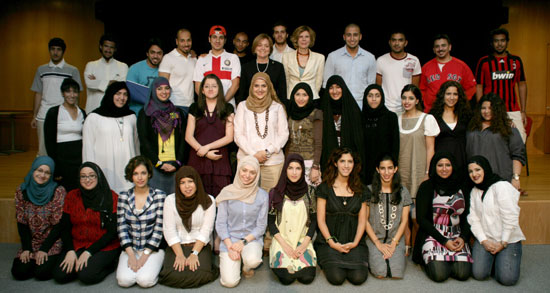
AUK students with Ambassador of the United States, Deborah Jones & Dr. Rawda Awwad
28, May 2009
AUK Debate Team Dominates Local Competition
The team representing AUK at the first annual Kuwait Open Debate tournament, held under the auspices of Mishaal Talal Fahad Al-Sabah, won the top award for English-language debating. The competition was held at the Qadsiya Sporting Club in Hawalli on Saturday May 23rd.
In the first round, the AUK team successfully argued for allowing international organizations to handle African disputes and conflicts. The second debate ended in a draw with GUST as AUK argued that the USA is a Christian country. The team of judges decided that based on our team's performance in the first debate, the AUK team was the overall competition winner. Each of our students was awarded a medal and cash prize. The event concluded with a dinner.
The AUK team was comprised of Nada A. Al-Hudaid, Dana Shamlawi, Yousef A Al-Kandari and Haya A Al-Qassar. The faculty who assisted in preparing the students were Professor Christopher Gottschalk, DR. Rawda Awwad and Dr. Christopher Ohan.
In the first round, the AUK team successfully argued for allowing international organizations to handle African disputes and conflicts. The second debate ended in a draw with GUST as AUK argued that the USA is a Christian country. The team of judges decided that based on our team's performance in the first debate, the AUK team was the overall competition winner. Each of our students was awarded a medal and cash prize. The event concluded with a dinner.
The AUK team was comprised of Nada A. Al-Hudaid, Dana Shamlawi, Yousef A Al-Kandari and Haya A Al-Qassar. The faculty who assisted in preparing the students were Professor Christopher Gottschalk, DR. Rawda Awwad and Dr. Christopher Ohan.
21, May 2009
Innovative Technology at AUK
The American University of Kuwait (AUK), a leading innovator of educational technology in Kuwait, announces the introduction of Interwrite's Personal Response System (PRS). AUK is the first educational institution in Kuwait to utilize this interactive teaching tool which enables the instructor to assess student comprehension of concepts immediately, questions are asked, and the students lock in answers. The Instructor can then interact with the class on subject matter and keep testing the class until all achieve the correct answer - all in real time.
The PRS system improves the quality of teaching in that it encourages student involvement, provides immediate feedback to students as well as professors and automates classroom recordkeeping. It records attendance automatically, checks to make sure all present are responding to questions and identifies anyone who fails to respond. Classroom participation is constantly checked. When questions are in quiz form, PRS objectively records student performance. This means classroom time is devoted to teaching and not record-keeping.
Dr. John Rutland, Associate Professor of Business at AUK, has led the way in testing and implementing the PRS System (known as "the clicker" at AUK) since Fall 2008. Dr. Rutland will be demonstrating "the clicker" at the American Business Council of Kuwait on May 25 and to AUK faculty on May 26.
The PRS system improves the quality of teaching in that it encourages student involvement, provides immediate feedback to students as well as professors and automates classroom recordkeeping. It records attendance automatically, checks to make sure all present are responding to questions and identifies anyone who fails to respond. Classroom participation is constantly checked. When questions are in quiz form, PRS objectively records student performance. This means classroom time is devoted to teaching and not record-keeping.
Dr. John Rutland, Associate Professor of Business at AUK, has led the way in testing and implementing the PRS System (known as "the clicker" at AUK) since Fall 2008. Dr. Rutland will be demonstrating "the clicker" at the American Business Council of Kuwait on May 25 and to AUK faculty on May 26.
Dr. John Rutland
Interwrite's PRS "the Clicker"
19, May 2009
New Private Universities in Kuwait Pin Their Hopes on U.S. Partners
THE CHRONICLE OF HIGHER EDUCATION
International
http://chronicle.com/weekly/v55/i37/37a02401.htm
From the issue dated May 22, 2009
New Private Universities in Kuwait Pin Their Hopes on U.S. Partners
By ANDREW MILLS
From the issue dated May 22, 2009
Kuwait
Sharply dressed in black suits and bright red ties, the two recruiters latch onto high-school students as they walk through the gates of Exhibition Hall No. 8 at the Kuwait fairgrounds. "I want to tell you about the American University of the Middle East," one of the recruiters says, following a visitor into the university fair.
"We're affiliated with Purdue University, from the United States. Do you know Purdue?" his sidekick adds, brandishing a clipboard emblazoned with the Purdue logo. "Would you like more information? Just fill out this card and visit our booth. We have a coffee bar there." These recruiters have figured out that the key to selling private higher education in Kuwait is to emphasize what may be their year-old institution's most important asset: its affiliation with a top foreign university.
"The international affiliation is very important. Purdue is a good American university. Its reputation is known," says Ahmad Al-Jaber, one of many high-school seniors who swarm around the American University of the Middle East's booth. "And it's not going to put its name with a school that is not good. Is it?" This implied assurance of quality is more than just an institutional strategy. It's a national one. When Kuwait lifted a ban on private higher education less than a decade ago, it decided that the best way to ensure the development of academically sound universities was to require all new institutions to have foreign partners.
That policy has helped the country rapidly build a credible private higher-education system where none existed before. In only eight years, eight private colleges have opened in this sprawling city-state, catering to some 13,000 students. Nine additional institutions have been authorized to open in the next few years.
Two other Kuwaiti universities have paired with American colleges. The Gulf University for Science and Technology, a polytechnic, teamed up with the University of Missouri at St. Louis; and the American University of Kuwait, a liberal-arts college, is in partnership with Dartmouth College. Other private colleges have Australian or European partners.
To be sure, Kuwait's private universities have not yet established the kind of academic profile
needed to place the small nation on the academic map. When it comes to the Middle East's higher-education renaissance, nobody mentions Kuwait's colleges in the same breath as New York University's soon-to-open campus in Abu Dhabi or Qatar's Education City, whose six U.S. branch campuses have established Doha as a college town on the Persian Gulf.
But here in Kuwait, the private universities have transformed the local scene.
For more than three decades, private higher education was banned in Kuwait. The giant, stateowned Kuwait University was the only option for students who wanted to earn a college degree in this emirate at the northern end of the Persian Gulf. But as the number of Kuwaitis edged close to a million during the 1990s, Kuwait University simply could not keep up with the demand.
Qatar and the United Arab Emirates faced similar challenges. But the unopposed rulers of those petrodollar-rich monarchies could set aside the kind of public money needed to build flashy campuses and lure top foreign universities to fill them up.
Politics are much more complicated in Kuwait, an aspiring democracy where a tumultuous parliament frequently exercises its power to oppose the ruling family's decisions, including on the national budget. Public money has never been as easily available as it has been among Kuwait's neighbors.
So the Ministry of Higher Education settled on a more cost-effective approach: It turned to the private sector.
The government has set out a number of requirements for private investors wishing to develop their own universities. The foreign partner must be ranked among the top 200 by The Times Higher Education Supplement or appear on U.S. News and World Report's top tier of colleges. The relationship between the Kuwaiti institution and its foreign partner must be a meaningful one. "We don't want to be in a situation where we're buying degrees - fancy degrees, with fancy names, but not enough meat," says Imad Alatiqi, secretary general of the Private Universities Council, which regulates all private universities in Kuwait. "We want substantive relationships, where there is a commitment of quality from the local people and from the international people."
Within those requirements, though, there is quite a bit of variety. The University of Maastricht Business School, in the Netherlands, and the Box Hill Institute, in Australia, have opened branch campuses or franchises of their home institutions in Kuwait. The Kuwaiti partners take a back seat when it comes to day-to-day operations. Other local investors have chosen to seek advice from their foreign partners, but manage their own academics and operations.
In those cases, the Private Universities Council requires the foreign partner to submit a formal opinion every time the Kuwaiti university makes a major academic decision, such as starting a program or hiring an academic officer. The council, which licenses and accredits all institutions, also sets the standards it expects private universities in Kuwait to meet. "Any arrangement between the two universities that can deliver those standards, we welcome," Mr. Alatiqi says.
A Liberal-Arts Alternative
In 2003 a group of investors led by Sheikha Dana Nasser Al-Sabah, a member of Kuwait's ruling family, wanted to establish an American-style liberal-arts college. They approached Dartmouth, which offered the kind of curriculum and approach to teaching they hoped to emulate.
They first called Dale F. Eickelman, a Dartmouth anthropologist. It was clear to him, he says, that the Kuwaiti investors wanted to develop a deep relationship.
"From the start, their instinct was to say to us, 'We don't just want you to sign off on things for us, we want you to help us aim for the highest level,'" says Mr. Eickelman, who has spent more than three decades working in the Middle East.
Dartmouth found the idea of helping build a liberal-arts college in the Middle East, a relatively uncommon concept here, hard to resist.
Six years later, hundreds of students now mingle in the shaded courtyards of the American University of Kuwait, switching seamlessly from Arabic to English and back again.
The compact campus on the outskirts of this dusty city, with its palm trees and glass buildings, could not seem farther from Hanover, N.H. But inside its classrooms, the approach to learning is similar.
The largely Western-educated faculty members do not expect their students to memorize lectures, as is common in Middle Eastern universities. Instead, Dartmouth has helped the American University of Kuwait set up the kind of curriculum and structure that, Mr. Eickelman says, encourage students to learn how to form their own opinions.
The university emphasizes a broad liberal education. After the Private Universities Council concluded that Kuwait had no need for anthropologists, Dartmouth worked with university officials to successfully argue that degrees in anthropology and sociology would prepare students for a wide variety of careers.
Dartmouth's agreement with the American University of Kuwait, which extends until at least 2013, is intentionally vague, says Laurel R. Stavis, executive director of the Dartmouth College-American University of Kuwait Project. There is no pro forma checklist of things the two institutions must do for each other. Instead the relationship is an "organic" one that changes to meet the Kuwaiti university's needs as it matures, Ms. Stavis says.
Administrators and faculty members from the American University of Kuwait are able to turn to a group of Dartmouth consultants, selected by Ms. Stavis and Mr. Eickelman, for advice on issues like governance, faculty recruiting, and communications. Students from both universities have begun traveling back and forth. This summer an American University of Kuwait faculty member will be awarded a fellowship to spend a month conducting research in Hanover.
Ms. Stavis is also helping develop a dual-degree program that would enable Kuwaiti students interested in engineering degrees, which are not offered by the American University of Kuwait, to complete their studies in New Hampshire, earning a Dartmouth degree.
The Kuwaiti university covers all of Dartmouth's expenses, but it is hardly a money-making opportunity for the college, Mr. Eickelman says. "The amount of money is a joke. Let's just say it's tremendously little for the work that is being done," he says, declining to say exactly how much money Dartmouth has brought in.
Building Up the Sciences
Joel Glassman, associate provost and director of the Center for International Studies at the University of Missouri at St. Louis, says his university is more interested in helping to build indigenous institutions overseas than in cloning the home campus and transplanting it to the other side of the world.
"It's not so mysterious," says Mr. Glassman, who heads up Missouri's work with the Gulf University for Science and Technology. "They're asking for our advice. Academics are not shy people. There is nothing we love more than being asked for advice."
Administrators and faculty members from St. Louis have helped the Kuwaiti university develop academic programs and curriculum, recruit faculty and staff members, and build the university's administrative organization.
The Gulf University for Science and Technology, which opened in 2002 and enrolls about 2,600 students, modeled its programs after those offered in Missouri. Students can earn undergraduate degrees in computer science, English, business, and mass communications, and a master's in business administration.
Like the American University of Kuwait, it requires all undergraduates to take a set of generaleducation courses.
The university has ambitious plans to spend $100-million to expand its campus to house a fullfledged engineering college.
This is Missouri's second such partnership in the Persian Gulf. It has advised the Modern College of Business and Science, in Muscat, Oman, since it opened in the early 1990s.
Now Missouri is helping the science-and-technology university as it seeks accreditation from AACSB International: the Association to Advance Collegiate Schools of Business.
Robert Cook, vice president for academic affairs at the university in Kuwait, is in the process of hiring 38 faculty members.
He says the relationship with the Missouri campus has given the university's recruitment efforts a boost. Attracting quality faculty members is often the biggest challenge new universities face in the region.
"For potential faculty members who have never been to the Middle East before, Kuwait can seem an intimidating place," says Mr. Cook. "So we did all the interviews for American candidates on the St. Louis campus, and a University of Missouri-St. Louis faculty member in the same field sat in on the interviews."
That assured candidates that the Gulf University for Science and Technology is a serious institution, strongly linked to a serious U.S. university, Mr. Cook says.
The Kuwaiti university has not yet built much of a regional reputation, but here in Kuwait its skills-based programs are highly regarded.
Mr. Cook boasts that 80 percent of its graduates are employed within six months of graduation.
Unlike most public-university graduates, who are automatically given government jobs, graduates of the Gulf University for Science and Technology typically find work in the private sector, where employers demand the best candidates, he says.
Gaining Credibility
Back at the university fair, the American University of the Middle East's recruiters have donetheir job: The university's booth is surrounded by teenagers filling out applications for next fall.
The campus is still in its first year of operation. About 100 students are enrolled in three degree programs - business, design, and information technology - which operate out of a single building at the edge of a windswept stretch of land.
Purdue has agreed to help the Kuwaiti university design and build "some very Purdue-like programs that will, over time, morph into the kind of programs they need in Kuwait," says Andrew Gillespie, Purdue's associate dean of international programs.
Kuwait's private universities face a clear challenge as they continue to expand. The best Kuwaiti students still prefer to study abroad. And two out of every five students - 20,000 of them take advantage of generous overseas government scholarships every year.
Mr. Al-Jaber, the Kuwaiti student, says that his first choice is to study abroad and his second choice is to study at the American University of Kuwait. But, he adds, the American University of the Middle East is not a bad third choice.
While that suggests that many Kuwaiti students still don't have confidence in the quality of their own higher-education system, Mr. Alatiqi, of the Private Universities Council, prefers to see the students as an untapped market.
"So you can see why we're so concerned about building quality universities," says Mr. Alatiqi, snapping his fingers. "We can pick up 20,000 more students just like that."
http://chronicle.com
Section: International
Volume 55, Issue 37, Page A24
Copyright©2009 by The Chronicle of Higher Education
International
http://chronicle.com/weekly/v55/i37/37a02401.htm
From the issue dated May 22, 2009
New Private Universities in Kuwait Pin Their Hopes on U.S. Partners
By ANDREW MILLS
From the issue dated May 22, 2009
Kuwait
Sharply dressed in black suits and bright red ties, the two recruiters latch onto high-school students as they walk through the gates of Exhibition Hall No. 8 at the Kuwait fairgrounds. "I want to tell you about the American University of the Middle East," one of the recruiters says, following a visitor into the university fair.
"We're affiliated with Purdue University, from the United States. Do you know Purdue?" his sidekick adds, brandishing a clipboard emblazoned with the Purdue logo. "Would you like more information? Just fill out this card and visit our booth. We have a coffee bar there." These recruiters have figured out that the key to selling private higher education in Kuwait is to emphasize what may be their year-old institution's most important asset: its affiliation with a top foreign university.
"The international affiliation is very important. Purdue is a good American university. Its reputation is known," says Ahmad Al-Jaber, one of many high-school seniors who swarm around the American University of the Middle East's booth. "And it's not going to put its name with a school that is not good. Is it?" This implied assurance of quality is more than just an institutional strategy. It's a national one. When Kuwait lifted a ban on private higher education less than a decade ago, it decided that the best way to ensure the development of academically sound universities was to require all new institutions to have foreign partners.
That policy has helped the country rapidly build a credible private higher-education system where none existed before. In only eight years, eight private colleges have opened in this sprawling city-state, catering to some 13,000 students. Nine additional institutions have been authorized to open in the next few years.
Two other Kuwaiti universities have paired with American colleges. The Gulf University for Science and Technology, a polytechnic, teamed up with the University of Missouri at St. Louis; and the American University of Kuwait, a liberal-arts college, is in partnership with Dartmouth College. Other private colleges have Australian or European partners.
To be sure, Kuwait's private universities have not yet established the kind of academic profile
needed to place the small nation on the academic map. When it comes to the Middle East's higher-education renaissance, nobody mentions Kuwait's colleges in the same breath as New York University's soon-to-open campus in Abu Dhabi or Qatar's Education City, whose six U.S. branch campuses have established Doha as a college town on the Persian Gulf.
But here in Kuwait, the private universities have transformed the local scene.
For more than three decades, private higher education was banned in Kuwait. The giant, stateowned Kuwait University was the only option for students who wanted to earn a college degree in this emirate at the northern end of the Persian Gulf. But as the number of Kuwaitis edged close to a million during the 1990s, Kuwait University simply could not keep up with the demand.
Qatar and the United Arab Emirates faced similar challenges. But the unopposed rulers of those petrodollar-rich monarchies could set aside the kind of public money needed to build flashy campuses and lure top foreign universities to fill them up.
Politics are much more complicated in Kuwait, an aspiring democracy where a tumultuous parliament frequently exercises its power to oppose the ruling family's decisions, including on the national budget. Public money has never been as easily available as it has been among Kuwait's neighbors.
So the Ministry of Higher Education settled on a more cost-effective approach: It turned to the private sector.
The government has set out a number of requirements for private investors wishing to develop their own universities. The foreign partner must be ranked among the top 200 by The Times Higher Education Supplement or appear on U.S. News and World Report's top tier of colleges. The relationship between the Kuwaiti institution and its foreign partner must be a meaningful one. "We don't want to be in a situation where we're buying degrees - fancy degrees, with fancy names, but not enough meat," says Imad Alatiqi, secretary general of the Private Universities Council, which regulates all private universities in Kuwait. "We want substantive relationships, where there is a commitment of quality from the local people and from the international people."
Within those requirements, though, there is quite a bit of variety. The University of Maastricht Business School, in the Netherlands, and the Box Hill Institute, in Australia, have opened branch campuses or franchises of their home institutions in Kuwait. The Kuwaiti partners take a back seat when it comes to day-to-day operations. Other local investors have chosen to seek advice from their foreign partners, but manage their own academics and operations.
In those cases, the Private Universities Council requires the foreign partner to submit a formal opinion every time the Kuwaiti university makes a major academic decision, such as starting a program or hiring an academic officer. The council, which licenses and accredits all institutions, also sets the standards it expects private universities in Kuwait to meet. "Any arrangement between the two universities that can deliver those standards, we welcome," Mr. Alatiqi says.
A Liberal-Arts Alternative
In 2003 a group of investors led by Sheikha Dana Nasser Al-Sabah, a member of Kuwait's ruling family, wanted to establish an American-style liberal-arts college. They approached Dartmouth, which offered the kind of curriculum and approach to teaching they hoped to emulate.
They first called Dale F. Eickelman, a Dartmouth anthropologist. It was clear to him, he says, that the Kuwaiti investors wanted to develop a deep relationship.
"From the start, their instinct was to say to us, 'We don't just want you to sign off on things for us, we want you to help us aim for the highest level,'" says Mr. Eickelman, who has spent more than three decades working in the Middle East.
Dartmouth found the idea of helping build a liberal-arts college in the Middle East, a relatively uncommon concept here, hard to resist.
Six years later, hundreds of students now mingle in the shaded courtyards of the American University of Kuwait, switching seamlessly from Arabic to English and back again.
The compact campus on the outskirts of this dusty city, with its palm trees and glass buildings, could not seem farther from Hanover, N.H. But inside its classrooms, the approach to learning is similar.
The largely Western-educated faculty members do not expect their students to memorize lectures, as is common in Middle Eastern universities. Instead, Dartmouth has helped the American University of Kuwait set up the kind of curriculum and structure that, Mr. Eickelman says, encourage students to learn how to form their own opinions.
The university emphasizes a broad liberal education. After the Private Universities Council concluded that Kuwait had no need for anthropologists, Dartmouth worked with university officials to successfully argue that degrees in anthropology and sociology would prepare students for a wide variety of careers.
Dartmouth's agreement with the American University of Kuwait, which extends until at least 2013, is intentionally vague, says Laurel R. Stavis, executive director of the Dartmouth College-American University of Kuwait Project. There is no pro forma checklist of things the two institutions must do for each other. Instead the relationship is an "organic" one that changes to meet the Kuwaiti university's needs as it matures, Ms. Stavis says.
Administrators and faculty members from the American University of Kuwait are able to turn to a group of Dartmouth consultants, selected by Ms. Stavis and Mr. Eickelman, for advice on issues like governance, faculty recruiting, and communications. Students from both universities have begun traveling back and forth. This summer an American University of Kuwait faculty member will be awarded a fellowship to spend a month conducting research in Hanover.
Ms. Stavis is also helping develop a dual-degree program that would enable Kuwaiti students interested in engineering degrees, which are not offered by the American University of Kuwait, to complete their studies in New Hampshire, earning a Dartmouth degree.
The Kuwaiti university covers all of Dartmouth's expenses, but it is hardly a money-making opportunity for the college, Mr. Eickelman says. "The amount of money is a joke. Let's just say it's tremendously little for the work that is being done," he says, declining to say exactly how much money Dartmouth has brought in.
Building Up the Sciences
Joel Glassman, associate provost and director of the Center for International Studies at the University of Missouri at St. Louis, says his university is more interested in helping to build indigenous institutions overseas than in cloning the home campus and transplanting it to the other side of the world.
"It's not so mysterious," says Mr. Glassman, who heads up Missouri's work with the Gulf University for Science and Technology. "They're asking for our advice. Academics are not shy people. There is nothing we love more than being asked for advice."
Administrators and faculty members from St. Louis have helped the Kuwaiti university develop academic programs and curriculum, recruit faculty and staff members, and build the university's administrative organization.
The Gulf University for Science and Technology, which opened in 2002 and enrolls about 2,600 students, modeled its programs after those offered in Missouri. Students can earn undergraduate degrees in computer science, English, business, and mass communications, and a master's in business administration.
Like the American University of Kuwait, it requires all undergraduates to take a set of generaleducation courses.
The university has ambitious plans to spend $100-million to expand its campus to house a fullfledged engineering college.
This is Missouri's second such partnership in the Persian Gulf. It has advised the Modern College of Business and Science, in Muscat, Oman, since it opened in the early 1990s.
Now Missouri is helping the science-and-technology university as it seeks accreditation from AACSB International: the Association to Advance Collegiate Schools of Business.
Robert Cook, vice president for academic affairs at the university in Kuwait, is in the process of hiring 38 faculty members.
He says the relationship with the Missouri campus has given the university's recruitment efforts a boost. Attracting quality faculty members is often the biggest challenge new universities face in the region.
"For potential faculty members who have never been to the Middle East before, Kuwait can seem an intimidating place," says Mr. Cook. "So we did all the interviews for American candidates on the St. Louis campus, and a University of Missouri-St. Louis faculty member in the same field sat in on the interviews."
That assured candidates that the Gulf University for Science and Technology is a serious institution, strongly linked to a serious U.S. university, Mr. Cook says.
The Kuwaiti university has not yet built much of a regional reputation, but here in Kuwait its skills-based programs are highly regarded.
Mr. Cook boasts that 80 percent of its graduates are employed within six months of graduation.
Unlike most public-university graduates, who are automatically given government jobs, graduates of the Gulf University for Science and Technology typically find work in the private sector, where employers demand the best candidates, he says.
Gaining Credibility
Back at the university fair, the American University of the Middle East's recruiters have donetheir job: The university's booth is surrounded by teenagers filling out applications for next fall.
The campus is still in its first year of operation. About 100 students are enrolled in three degree programs - business, design, and information technology - which operate out of a single building at the edge of a windswept stretch of land.
Purdue has agreed to help the Kuwaiti university design and build "some very Purdue-like programs that will, over time, morph into the kind of programs they need in Kuwait," says Andrew Gillespie, Purdue's associate dean of international programs.
Kuwait's private universities face a clear challenge as they continue to expand. The best Kuwaiti students still prefer to study abroad. And two out of every five students - 20,000 of them take advantage of generous overseas government scholarships every year.
Mr. Al-Jaber, the Kuwaiti student, says that his first choice is to study abroad and his second choice is to study at the American University of Kuwait. But, he adds, the American University of the Middle East is not a bad third choice.
While that suggests that many Kuwaiti students still don't have confidence in the quality of their own higher-education system, Mr. Alatiqi, of the Private Universities Council, prefers to see the students as an untapped market.
"So you can see why we're so concerned about building quality universities," says Mr. Alatiqi, snapping his fingers. "We can pick up 20,000 more students just like that."
http://chronicle.com
Section: International
Volume 55, Issue 37, Page A24
Copyright©2009 by The Chronicle of Higher Education
18, May 2009
Annual Dinner at American University of Kuwait
The American University of Kuwait held its Annual Faculty and Staff Dinner on May 7, to celebrate faculty and staff who have served AUK for five years and honor exemplary staff for their outstanding performance in all areas of university life. The awards are aimed at excellence in leadership skills, organizational skills, people skills and service to the AUK Community. Some even showcased hidden talents including Karaoke contestants Faten Al-Kadiri and Saleem Aboobacker. This event was sponsored by Habchi and Chalhoub, Tanagra, Swarovski, Tumi, Longchamp, Digits, KCCEC, Gulf Insurance Company, Al-Zuhair Medical Center, Trafalgar and KAPICO.
Five Year Service Awardees
Abdulaziz Abal Instructor, Intensive English Program (IEP)
Abdulraheem Sallam, Accountant (Receivables)
Ali Charara, Assistant Professor, Biology
Alia El Assaad, Outreach & Events Coordinator
Amna Al Omare, Director of Library
Anastacio Prades, Senior Instructor - IEP
Andrea Al Adwani, Student Affairs Counselor
Athmar Al-Salem, Assistant Professor of Management
Carol Ann Ross, Dean of Student Affairs
Craig Loomis, Division Head of Humanities and Arts
Dalal Al-Hubail, Corporate/Public Training Advisor
David Hart, Lab Coordinator, IEP
Fatma Khamis, Media & Communication Officer
Fernand Tessier, Associate Professor, Mathematics
Ghazi Nassir, Associate Professor, English & Literature
Hala Auchey, Executive Assistant to the President
Hana Kaouri, Library Automation Analyst
Hana Mathews, Assistant Registrar
Hussein Diab, Database Administrator
Jeremy Cripps, Professor of Accounting
John Barnett, Senior Instructor - IEP
Kalimullah Bhuiyan, AUK Driver
Liaquat Ali, Facilities Technician
Lisa Urkevich, Associate Professor - Music
Maha Khlat, Director of Information & Technology
Margaret Combs, Director of IEP
Michael McMurray, Instructor/Coordinator, IEP
Neamat Mosaad, Associate Professor, Physics
Pauline Arthur, Instructor, IEP
Rawda Awwad, Assistant Dean for Accreditation and Curriculum
Rebecca Loomis, Instructor/Coordinator, IEP
Shereef Abu Al-Maati, Division Head, Sciences and Engineering
Syed Fazululla, Driver/Stores Assistant
Following is a list of Awardees
Pareen Tajani - TEAM LEADER
Theodore Kruse - TEAM LEADER
Micheline Zouein - THE MOST HUMOROUS EMPLOYEE
Hala Al-Abdulrazzaq - THE MOST CREATIVE EMPLOYEE
Mazin Younis - EMPLOYEE OF THE YEAR (Finance& Administration)
Amal Hadeed - EMPLOYEE OF THE YEAR (Academic Affairs)
Basema Danaa - EMPLOYEE OF THE YEAR (Student Affairs)
Margaret Combs - EMPLOYEE OF THE YEAR (Management)
Five Year Service Awardees
Abdulaziz Abal Instructor, Intensive English Program (IEP)
Abdulraheem Sallam, Accountant (Receivables)
Ali Charara, Assistant Professor, Biology
Alia El Assaad, Outreach & Events Coordinator
Amna Al Omare, Director of Library
Anastacio Prades, Senior Instructor - IEP
Andrea Al Adwani, Student Affairs Counselor
Athmar Al-Salem, Assistant Professor of Management
Carol Ann Ross, Dean of Student Affairs
Craig Loomis, Division Head of Humanities and Arts
Dalal Al-Hubail, Corporate/Public Training Advisor
David Hart, Lab Coordinator, IEP
Fatma Khamis, Media & Communication Officer
Fernand Tessier, Associate Professor, Mathematics
Ghazi Nassir, Associate Professor, English & Literature
Hala Auchey, Executive Assistant to the President
Hana Kaouri, Library Automation Analyst
Hana Mathews, Assistant Registrar
Hussein Diab, Database Administrator
Jeremy Cripps, Professor of Accounting
John Barnett, Senior Instructor - IEP
Kalimullah Bhuiyan, AUK Driver
Liaquat Ali, Facilities Technician
Lisa Urkevich, Associate Professor - Music
Maha Khlat, Director of Information & Technology
Margaret Combs, Director of IEP
Michael McMurray, Instructor/Coordinator, IEP
Neamat Mosaad, Associate Professor, Physics
Pauline Arthur, Instructor, IEP
Rawda Awwad, Assistant Dean for Accreditation and Curriculum
Rebecca Loomis, Instructor/Coordinator, IEP
Shereef Abu Al-Maati, Division Head, Sciences and Engineering
Syed Fazululla, Driver/Stores Assistant
Following is a list of Awardees
Pareen Tajani - TEAM LEADER
Theodore Kruse - TEAM LEADER
Micheline Zouein - THE MOST HUMOROUS EMPLOYEE
Hala Al-Abdulrazzaq - THE MOST CREATIVE EMPLOYEE
Mazin Younis - EMPLOYEE OF THE YEAR (Finance& Administration)
Amal Hadeed - EMPLOYEE OF THE YEAR (Academic Affairs)
Basema Danaa - EMPLOYEE OF THE YEAR (Student Affairs)
Margaret Combs - EMPLOYEE OF THE YEAR (Management)