

News
Three presentations on dolphin and whale life were given during a symposium on cetacean life at the American University of Kuwait (AUK) last week. The three part event was held in the multipurpose room on April 28th. It began with a lecture by marine mammalogist Yousef Bohadi entitled, "Whale Watching: Introduction, possibility, and science," continued with a lecture by Mike Pope, naturalist and chairman of Kuwait Ornithological Rarities Committee, entitled "Cetaceans of Kuwait," and finally finished with footage of the Ionian Dolphin Project in Greece to encourage students to volunteer for cetacean research.
The event was sponsored by the AUK library, and was an initiative of Ms. Ghaidaa Mohamad, Arabic Instructor at the Department of Arabic and Foreign Languages, in cooperation with the Al-Akhdar Club (Environmental Club), and the kind assistance of AUK student Mr. Khaled Al-Abdulaqader. Al-Akhdar Club has held similar environmental forums in the past, with last year's event also focusing on cetacean research and conservation.
The first lecture entitled, "Whale Watching: Introduction, possibility, and science," given by Yousef Bohadi, introduced the field of marine mammalogy and provided an outline of the methods scientists use to track the animals and document them in their natural habitats. Bohadi directed his comments at those excited about cetaceans, saying that "volunteer programs offer the best chance for a close up look at these marine mammals" for students who want to get involved in conservation and observation efforts. Bohadi's own volunteer experience in Iceland and the Comoros Islands nurtured his passion for marine mammalogy, and enabled him to serve as an example and an inspiration to the AUK students present. He finished his lecture with a brief description of the dolphin species present in Kuwait, and demonstrated to the audience the uniqueness of each through various images and sound recordings of dolphins in Kuwaiti waters and beyond.
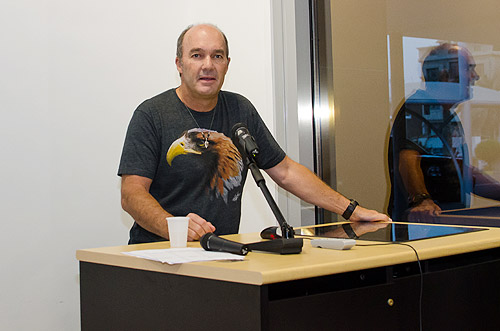
Mike Pope's lecture entitled "Cetaceans of Kuwait" was designed to "raise awareness of the fact that there are indeed Apex predators in the unique marine eco-system we call the Arabian Gulf." Pope described how he finds many people "unaware of the treasures they have here in Kuwait" and thus does presentations like this to "try and show what makes Kuwait unique in terms of its biodiversity." The lecture focused primarily on the presence of dolphins along the coast and further out in the gulf; the three main species present in Kuwait are the Indo-Pacific Humpback Dolphin (coastal species), the Indo-Pacific Bottlenose Dolphin (coastal species), and the Black Finless Porpoise (offshore species). Pope concluded his lecture by explaining how to distinguish between the three species, and reiterated the importance of reporting dolphin sightings, so that a larger database of opportunistic sightings can be built up, and the dolphins' habitat better preserved as a result.
The footage of the Ionian Dolphin Project in Greece was meant to encourage interested students to volunteer for cetacean research as Yousef Bohadi discussed in his lecture, and showed students an excellent example of a cetacean research project designed to track the "distribution of cetacean species present in the area and identify key habitat for their conservation." The movie provided an excellent audiovisual conclusion to two informative lectures, and inspired students to take part in the conservation efforts of their marine species here in Kuwait.
AUK was lucky to have KTV 2 cover the entire event. To view a video of the symposium, please click on the following link:
The Ionian Dolphin Project aims to ensure the long-term viability of dolphin species living in coastal waters of the eastern Ionian Sea. Research by Tethys Research Institute is providing support to dolphin conservation efforts, through actions including:
continued monitoring of dolphin groups through field research methods including boat surveys and individual photo-identification, to detect population trends and identify critical habitat; research on factors threatening the local ecosystems, particularly excessive fishing; public awareness, education and capacity building initiatives (e.g. involvement of a large number of students and volunteers, dolphin events organized locally, public presentations, lectures at local schools, production of multimedia); contacts and meetings with the local Authorities and fishermen organizations, aimed to raise awareness on the need of establishing measures to protect dolphins and implement existing regulations (e.g. to prevent illegal fishing); dissemination of information in the scientific literature and delivery of management proposals to international agreements and bodies concerned with the protection of marine biodiversity. More information can be found at: www.ioniandolphinproject.org
Released by the Office of Public Affairs on the 13th May 2013
Photography by the Office of Public Affairs (C) 2013
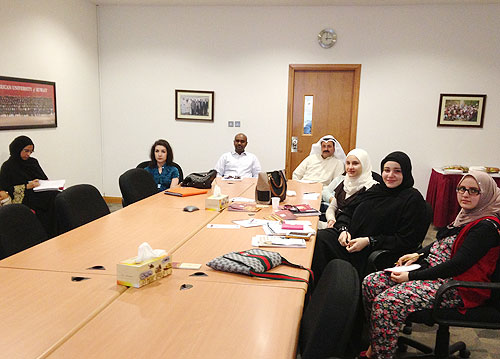
In celebration of the World Press Freedom Day, the American University of Kuwait (AUK) participated in a live web discussion on May 2nd with the CNN Senior Director for Social News.
The event, sponsored by the AUK Library, featured Lila King, who leads CNN's user-generated news website called iReport. King shared her thoughts and personal stories on citizen journalism and answered questions on the topic from different communities. Participants in the discussion tuned in from various parts of the world including Colombo, Dhaka, Hong Kong, Kuwait City, Lagos, and Riyadh, to ask questions about what King also refers to as "participatory journalism."
According to King, iReport is an initiative by CNN that allows regular citizens from around the globe to contribute to newsgathering by submitting videos, photographs, and stories about their communities. It is a means through which people can document their daily experiences and share them with the world in a journalistic setting. According to CNN, the tool invites everyone to have the opportunity to contribute and be part of story coverage. This allows a personal and nuanced view of an event or experience to be broadcasted to a global audience from a unique perspective. According to King, these experiences take the public into the "heart of the story" and help "expand our knowledge of communities in every corner of the world."
She further expressed that "seeing a story from the inside out and learning what it's really like to live through something and experience it is the best way in many cases to convey to the rest of us why we should care, why something really matters, and why we should get invested."
iReport is used mostly for stories related to breaking news, natural disasters, and weather reports, as often, a person can film, photograph, or describe the action on the spot as it unfolds around them faster than a news agency can. The prevalence of technological tools such as handheld digital devices and smartphone cameras has made this possible, which is transforming the way we experience the news.
One of the questions featured in the discussion was by an AUK participant, who asked if there was a particularly important and memorable contribution made to iReport. One contribution that stood out was during the Haitian earthquake in 2010. iReport received thousands of photos of the devastation, and people began to post photos of lost family members and friends on the platform. As stated by King, iReport started the process of restoring contact between separated family members through an initiative called "Looking for loved ones." By combining CNN's worldwide reach with social media, they created a compelling service. CNN formed a database of people who had been lost and found that was continuously updated in real time. Through the database, people with family and friends in Haiti were able to obtain information about their loved ones from others within the community who had seen them. The service was an example of a collaborative effort between CNN and iReporters who contributed worldwide.
In discussions of citizen journalism, there is always the question of whether citizen journalism poses a threat to professional journalism. King supports the opinion that professional journalists tend to adhere to journalistic ethics and standards that seek fair and balanced coverage, whereas citizen journalists may lack the expertise and practice of gathering, fact checking, and analyzing information, and thus each type of journalism has its own niche.
In response to a question raised by a viewer from Ghana concerning a code of ethics for citizen journalists, King mentions that a code for participatory journalists is yet to be established. She further discussed at length the "dangers" of social media as Facebook, Twitter, and Instagram. When it comes to social media, it is crucial that news channels ensure that citizen journalists report with integrity and serve their audiences candidly, much like professional journalists strive to ensure that information disseminated is truthfully conveyed. Journalists, therefore, have the responsibility to verify what circulates in social media by sifting truth from falsehood. "When we are all documenting the world, it just means we bear a shared responsibility to maintain ethics," King says.
To conclude her argument, King stressed that both schemes of journalism can coexist and collaborate, especially in instances when professional journalists have difficulty accessing the setting or people crucial to their story for one reason or another. "The combination and collaboration between citizens and professionals is what makes citizen journalism so incredibly powerful," King confirms. When citizens tell stories about something they are involved in, it becomes part of the larger global conversation, as the role of traditional media is to "pick up the signal, tease out the stories, and amplify them through their channels." This helps shed light on various issues that need attention. It is that connection that makes both citizen and professional journalists build a collaborative, communal, and symbiotic relationship with one another.
An audience member is no longer merely a viewer of news anymore. As a result of citizen journalism, citizens can now help add new voices to the daily commentary on world events.
Commenting on the live web discussion, Asma Al-Kanan, AUK Library Director, said, "It was really exciting to me to see students interact with international experts and other students and groups around the world by submitting questions through digital media. This is an interesting new way of exchanging thoughts and getting involved globally."
Released by the Office of Public Affairs on the 12th May 2013
Photography by the Office of Public Affairs (C) 2013
Last week, AUK held its semiannual President's Honor Roll / Dean's Honor List ceremony to award its top student academic achievers for the 2012 Fall Semester. The ceremony, which was held at the AUK Liberal Arts Auditorium, drew a large audience of students, parents, AUK faculty and staff, who took pleasure in seeing the students' hard work being recognized and rewarded.
During the event, AUK Interim President Dr. Nizar Hamzeh recognized the 24 students on the President's Honor Roll, a high distinction exclusively awarded to those few students who maintained a 4.0 GPA for the term. The Dean's Honor List, a distinction awarded by the college Deans to students who maintained a minimum GPA of 3.7, featured 134 recipients, 75 of whom belonged the College of Arts & Sciences, while 59 belonged to the College of Business & Economics.
The following students were recognized for their academic achievements:
Fall 2012 President's Honor Roll
| Aya Abdulhamid | Njoud Aweis |
| Yasmin Abou Zeid | Emannoel Cabildo |
| Mohammed Yousr Al-Ayyoubi | Fatma Ebrahimi |
| Ayat Al-Bloushi | Nada El-Badry |
| Alaa Eddin Al-Chalabi | Anwar Esmaeel |
| Rataj Al-Hasawi | Noor Kassem |
| Aisha Al-Hunaidi | Fatma Mansour |
| Maisaa Al-Musalam | Batul Sadliwala |
| Dina Al-Qassar | Ayatallah Sharawi |
| Nasser Al-Roshoud | Maymoonah Toubeh |
| Salem Al-Salem | Rana Youssef |
| Farah Al-Toum | Sally Zaghloul |
Fall 2012 Dean's Honor List
College of Arts & Sciences
| Khaled Abdel Ghaffar | Rana El-Zoheiry |
| Aya Abdulhamid | Anwar Esmaeel |
| Yasmin Abou Zeid | Zahraa Hamadi |
| Mariam Abulhasan | Farah Harb |
| Shahad Al Asfour | Ahmed Hassanein |
| Geehan Al-Ansari | Ahmed Heiba |
| Manar Al-Bader | Ahmed Himmow |
| Zainab Al-Baksami | Nagaut Hussain |
| Ayat Al-Bloushi | Mahmoud Imdoukh |
| Shereen Al-Bloushi | Joseph Issa |
| Alaa Eddin Al-Chalabi | Kawee Jarach |
| Shahad Al-Faily | Sara Kamali |
| Sara Al-Faraj | Noor Kassem |
| Abdulmohsen Al-Fares | Salli Khaddag |
| Radia Alfili | Stephanie Khalil |
| Aisha Al-Fuwaires | Yasser Khalil |
| Sulaiman Al-Ghounaim | Amira Mahmoud |
| Ajab Ali Hussain | Nader Makki |
| Hind Al-Khatrash | Manar Mashal |
| Fatima Al-Langawy | Marina Matta |
| Dana AlMansouri | Sara Mohamed |
| Rawan Al-Mukhled | Ahmed Mohammed |
| Assayel Al-Mutawa | Dina Naser |
| Mefleh Al-Muttairy | Vincent Puyat |
| Lamis Al-Nazer | Fatma Qatan |
| Nourah Al-Omar | Omar Raad |
| Dina Al-Qassar | Ali Rady |
| Salem Al-Salem | Sarah Raji |
| Batol Al-Saraf | Sandra Saad |
| Manal Al-Sharah | Ramy Saboungui |
| Hashim Al-Sughayer | Batul Sadliwala |
| Abdulwahab Al-Sultan | Haseeb Shahzad |
| Shaza Al-Wattar | Hanah Sharak |
| Anwar Behbehani | Neda Shirazi |
| Farah Bossakhar | Maymoonah Toubeh |
| Emannoel Cabildo | Jessie Trago |
| Sandra Daniel | Rita Yamout |
| Mohammed El-Shafei |
College of Business & Economics
| Laila Abdal | Fares Al-Tawheed |
| Fatma Abdul Husain | Farah Al-Toum |
| Haleema Ahmed | Fahad Al-Wadani |
| Sawsan Al-Ajmi | Alia Assaf |
| Farah Al-Alami | Njoud Aweis |
| Mohammed Yousr Al-Ayyoubi | Sanjida Chowdhury |
| Bibi Al-Behbehani | Fatma Ebrahimi |
| Khaled Albusairi | Noor El-Ali |
| Afnan Al-Daqqaq | Nada El-Badry |
| Dalal Al-Dousari | Razan Farhat |
| Lojain Al-Falah | Carol Ghali |
| Nora Al-Ghanim | Karima Juma |
| Rataj Al-Hasawi | Jihan Kablaoui |
| Ghalyah Al-Humaidi | Manit Kaur |
| Aisha Al-Hunaidi | Said Khodor |
| Bader Al-Mailem | Ali Majed |
| Nora Al-Mezayn | Fatma Mansour |
| Firas Al-Mobarek | Sophia Massouh |
| Faiyez Al-Mousharji | Ahmed Mohamed Tawfik |
| Maisaa Al-Musalam | Dalal Mohammad |
| Razan Al-Obaid | Ayah Mowafi |
| Lolwa Al-Omar | Mona Padpood |
| Nora Al-Omar | Rawan Rajeh |
| Dalal Al-Qattan | Lina Salout |
| Nasser Al-Roshoud | Ayatallah Sharawi |
| Khaldah Al-Rowdan | Farah Shimi |
| Muneerah Al-Sabah | Rana Youssef |
| Danah Al-Selmi | Sally Zaghloul |
| Latifah Al-Shayea | Abdulrahman Zaghloul |
| Shehab Al-Shehab |
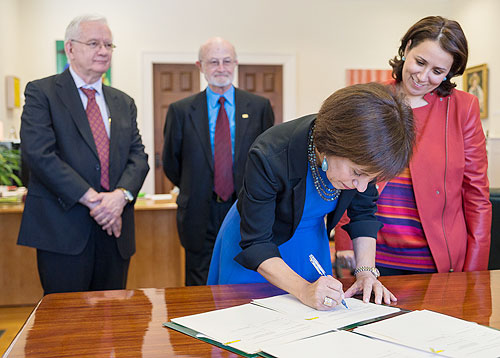
Leaders from Dartmouth and the American University of Kuwait (AUK) met April 25 to reaffirm their partnership, which deepens and expands the liberal arts experience on both campuses, by signing a third memorandum of understanding between the institutions.
Calling the partnership a "wonderful opportunity," Interim President Carol L. Folt welcomed Sheikha Dana Nasser Al-Sabah; Chair of AUK's Board of Trustees; Amal Binali, Vice President of Admissions and Public Affairs at AUK; and Earl (Tim) Sullivan, a member of AUK's Board of Trustees.
"Global partnerships are critically important to Dartmouth in an increasingly connected world. We are so proud to partner and collaborate with an institution like AUK that values the kind of strong liberal arts education Dartmouth has been committed to for nearly 250 years," Folt said.
Since the first agreement was signed 10 years ago, Dartmouth has offered valuable support, providing advice on curriculum planning, faculty hiring, and research collaboration, Shaikha Dana Nasser Al-Sabah said.
Each memorandum of understanding reaffirms the partnership for five years; the most recent agreement was signed in 2008 in Kuwait. AUK, which has graduated more than 1,000 students, was founded in 2003. That same year, Dartmouth began advisory, consulting, and cooperative projects with the university.
In the last decade, Dartmouth and AUK faculty and students have traveled between campuses to participate in cross-cultural internships, fellowships, and research. AUK students can earn a dual-degree in engineering, in which they study at AUK and at Thayer School of Engineering.
"Dartmouth has been on our side from day one," Shaikha Dana said. "We do recognize the important role that Dartmouth is playing in AUK's success. Dartmouth is a model to which we aspire in developing our own programs and curriculum, and creating the intellectual infrastructure of what we believe a liberal arts academic community should be."
Shaikha Dana Al-Sabah also said there have been challenges in positioning AUK, the first private liberal arts university in Kuwait. But Dartmouth, as "the partner in our evolution," has been pivotal to AUK's success, she said. "As we prepare to celebrate AUK's 10-year anniversary, we look forward to continuing this relationship as we seek to imbed a liberal arts culture into the Kuwaiti higher education system."
Earlier in the day, Shaikha Dana Nasser Al-Sabah participated in an anthropology seminar, "Thought and Change in the Middle East and Central Asia," taught by Dale F. Eickelman, the Ralph and Richard Lazarus Professor of Anthropology and Human Relations.
Eickelman, the relationship coordinator for the Dartmouth-AUK Program since its beginning, co-signed the agreement and was joined by a group of Dartmouth colleagues, including Lindsay Whaley, interim provost and professor of linguistics and classics; Ann Root Keith, chief operating and interim senior vice president for advancement; and Elizabeth Hindmarsh, the Program Manager for the Dartmouth-AUK Program.
The meeting in the President's Office included an exchange of gifts. Shaikha Dana Nasser Al-Sabah presented President Folt with a medallion of AUK's seal, and Folt presented Shaikha Dana with a clock that has two faces, one set to the time at AUK and the other to the time at Dartmouth.
"Dartmouth's entire community has benefited from the deep, symmetrical alliance that our two institutions share, "Folt said. "The breadth and depth of partnerships between the faculty, students, and staff at both schools serve as a powerful cross-cultural model for liberal arts education in the 21st century."
The AUK leaders also met with students at a reception at the John Sloan Dickey Center for International Understanding, and attended a dinner at the President's house.
Released by the Office of Public Affairs on the 7th May 2013
Photography by: Eli Burakian | Dartmouth College Photographer | Office of Public Affairs
The American University of Kuwait hosted the 2013 AUK Academic Showcase last week to share samples of the unique projects, academic activities, and achievements of AUK students and faculty members with the community. The two-day event showcased advertising productions, musical performances, art demonstrations, theatre displays, and academic presentations in various fields and disciplines. Faculty members contributed by making presentations in their relevant fields of expertise, in an attempt to show students a glimpse of what those fields encompass and help them identify their academic interests.
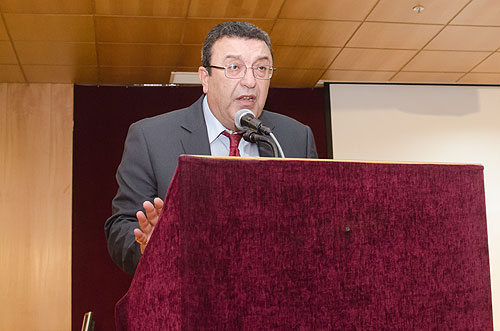
In his opening speech, AUK Interim President, Dr. Nizar Hamzeh, stressed the importance of the Academic Showcase as a reaffirmation of "our commitment to excellence in teaching and research." According to Dr. Hamzeh, the showcase aims to provide the students with "experience that will be useful in furthering their education and careers," and to "allow the campus community to experience the varied scholarly and creative interests of our students."
The Academic Showcase is held on a regular basis as a celebration of the AUK mission to "foster an environment encouraging critical thinking, effective communication, personal growth, service, and leadership."
Released by the Office of Public Affairs on the 7th May 2013
Photography by the Office of Public Affairs (C) 2013
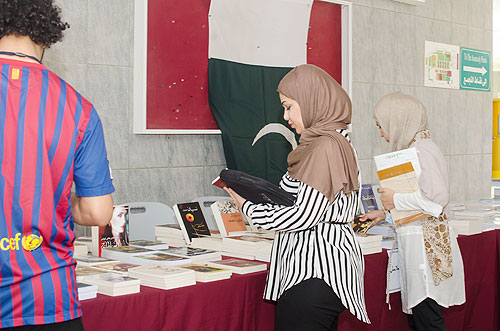
The Arabic Literature Club held its first Literary Book Fair in the Central Hallway at AUK, featuring a number of famous publishers and book authors. The fair attracted a significant number of students, faculty members and external visitors, who came to browse the literary collections offered by famous publishers, among which were: Jarir bookstore, Al-Salasil, Afaq bookstore, Kuwait Writers Association, Dar Al-Farasha, Dar Masaa, Nova Plus for publishing, Al-Babtain central library for Arabic poetry, Dar Suad Al-Sabah, Al-Aujairy bookstore, and the National Council for Culture, Arts and Letters.
The fair also hosted a number of renowned book authors who came to meet with the students and sign book copies. Bader Al Olayan was one of those writers, and discussed his novel Yesterday with the AUK students and visitors. Also present were, Thuraya Al Baqsami, for her book, Time of the Red Piper, and Waleed Al-Musalam, for his book 30 Silver Beats.
The Arabic Literature Club at the American University of Kuwait, currently led by Enjood Al-Hasawi, is a student organization interested in different aspects of the Arabic language and culture, such as Arabic poetry and literature. The main purpose of the club is to reveal the Arab identity, and practice the Arabic language at AUK. Most of the club events currently focus on Arabic literature and poetry. The Arabic Club aims to hold more cultural events that will include Arabic music and the hosting of famous experts in the Arabic language to share their experience and thoughts with the students. All events hosted by the Arabic Club are being done in association with the Arabic Department at AUK.
Released by the Office of Public Affairs on the 1st May 2013
Photography by the Office of Public Affairs (C) 2013
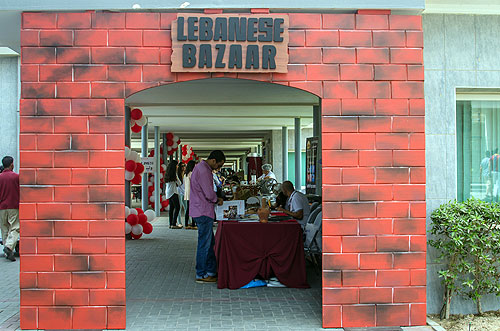
The Lebanese Culture Club (LCC) at the American University of Kuwait (AUK) organized its 2nd Annual Lebanese Bazaar. The event took place on the AUK Campus, and was open to the AUK community, friends, and family. The Lebanese Culture Club at AUK is a student club representing the Lebanese community and population of AUK, and aims to promote the country of Lebanon, its culture, and its history to the AUK community, while also serving to educate them by organizing events that are entertaining, educational, and beneficial for students and campus. This is how the idea of the Lebanese Bazaar was introduced; the desire was to combine all these elements into one major event.
The Lebanese Bazaar included different companies that showcased Lebanese products and services, such as restaurants, shops, artisans, and many more, that had the opportunity to promote and sell their various items. These vendors included Lama Fruits & Produce, Casper & Gambinis, Falafel Nadia, Sandy Snacks, Arzet Lebnan, Let's Popcorn, Bayt Al-Saboun El-Lebnany, Nazih Cosmetics, Beirut International Exhibitions Company, Buy2Best, and numerous vendors for hand-made accessories, jewelry, crafts, and souvenirs. The Lebanese Culture Club set up a booth that displayed different Lebanese crafts, and created engraved key-chains made of authentic Lebanese cedar wood. The bazaar also included traditional Lebanese music, which played throughout the event, as well as a traditional Lebanese Dabke performance by a group of professional performers.
Student Club President, Mireille Tannnous said, "The Lebanese Bazaar is a perfect opportunity for AUK students to get to know the Lebanese culture, as well as the participating companies to promote their services to the public. It's a mutual benefit!"
In addition, there were various displays around campus, such as a Lebanese Wall of Fame, which educated students about famous people around the world who are Lebanese or of Lebanese origins, and a photo display of famous and historic places that are landmarks in Lebanon. More importantly, there was also a student educational activity involving the Lebanese "Bosta" or mini-bus. This activity involved a display of a mini van with a poster explaining the history and meaning of how the "Bosta" was involved in the "Ain el-Rammaneh" incident that sparked of the Lebanese Civil War in 1975. And, as a sign of symbol of peace, students took turns writing their messages of peace, hope and better future on the van.
Amer El-Assaad, Assistant Director of PR & Marketing at AUK, and Advisor for the Lebanese Culture Club, also commented on the success of the event, saying, "based on the success of last year's bazaar, which was much smaller, the student club decided to have it again this academic year, but much larger in scale, and with more activities. As the club advisor, I of course supported their decision, and assisted as much as I could with the event."
The event was sponsored by Yiaco Apollo Medical Center, which served as the official sponsor for the event. Yiaco Apollo Medical Center in Kuwait agreed to come on board as sole sponsors for the Bazaar, to get involved with community outreach, and to promote their services involving the latest and most comprehensive technologies in medical care and beauty services. Mr. Abdulkader Al-Mursal, Marketing Manager of Yiaco Medical Center, is also a 2008 graduate of AUK, and saw a perfect opportunity to get involved with AUK again as an alumnus.
Released by the Office of Public Affairs on the 1st May 2013
Photography by the Office of Public Affairs (C) 2013
Each year, a wide variety employers visit the American University of Kuwait to share information about their organizations, and to discuss future employment opportunities with AUK students.
On the 23rd of April, it was time to kick-off the recruitment season with the AUK 9th Annual Career Fair. Held in the AUK Auditorium, the Career Fair brought together 28 reputable local and multinational companies from all around Kuwait to meet and speak with AUK students about potential career opportunities. Organized by the AUK Career Services and Wellness Center (CSW), the fair was the biggest yet, and provided students with a valuable chance to make contacts with companies, and market themselves to prospective employers.
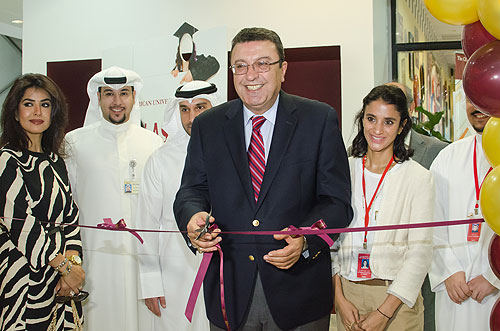
During the opening ceremony, AUK Provost and Interim President, Dr. Nizar Hamzeh, cut the ribbon marking the official inauguration of the fair. He gave an opening speech where he welcomed all participants and stressed that, "This event is an important opportunity to form potential partnerships. It helps students advance their careers as professional leaders in their communities." Hamzeh emphasized that recruitment is a two-way process in which students seek to make themselves attractive to employers through their skills and get recruited. "It can be life-changing for potential students," he added. This event, exclusively for AUK students and graduates, was sponsored by the platinum sponsors Al-Ahli Bank of Kuwait (ABK) and Gulf Bank; the gold sponsors KIPCO Asset management, 4fest and 4films Printing Group, and Ahli United Bank; and the silver sponsors Al-Homaizi Ltd., IKEA, Hyundai Green Industries (HGI), United Real Estate Company, Al Ghanim Industries, and Commercial Bank of Kuwait.
Abir Itani, AUK Career and Personal Counselor at the Career Services Center said, "The fair is a very important chance to prepare students for potential employment. We have many representatives from AUK as well."
During the event, students had an opportunity to investigate their career paths and directly gain advice on their resumes from professionals and various corporate representatives, some of whom are AUK graduates. Speaking as an AUK graduate and representative of Al-Ahli bank, Mariam Bin Nakhi said she is proud of AUK students, and that the institute opens broad opportunities for its students.
The fair proved to be very successful. It is a great platform for students to maximize their chances of finding the right career placement for them, while also making a connection with their possible future employers. AUK equips students with the necessary skills needed to prepare them for a successful future.
The Career Services and Wellness Center (CSW) aims to promote wellness education, serve as a resource for students, staff and faculty, and provide counseling for students and alumni. Counseling follows American Counseling Association (ACA) standards which require confidentiality between client and counselor. Career services provide career counseling, professional trainings, and job readiness. Personal counseling addresses a wide range of academic, personal and social concerns. Disability services offer reasonable accommodations and assistance for students. The CSW is committed to help students learn, think and become...
Released by the Office of Public Affairs on the 28th April 2013
Photography by the Office of Public Affairs (C) 2013
From 22-24 March 2013 the Center for Gulf Studies at the American University of Kuwait held a three-day Gulf Studies Symposium on the theme "Gulf Cities: Space, Society, Culture." According to the Director of the CGS, Dr. Farah Al-Nakib, in her opening remarks: "The Gulf region ranks among the most urbanized in the world, with an average of 84% of the population living in urban areas (which increases to 91% when excluding Saudi Arabia, Iraq, and Iran). Furthermore, the cities of the Arab Gulf coast are currently setting global benchmarks in urban growth rates and city development projects. Given this distinctly urban identity, almost every aspect of Gulf society, culture, and politics can be analyzed and understood through the lens of the city." The objective of the GSS was to analyze Gulf cities from both their historic and present-day perspectives, and to include cities in areas historically, geographically, and culturally connected to the Arab Gulf coastal region: Iran, Iraq, Yemen, and the Red Sea region of Saudi Arabia.
The three-day symposium brought together a total of forty leading scholars from Kuwait, the Gulf and Middle East, Europe, the United Kingdom, and the United States to present current and innovative research on the space, society, and culture of Gulf cities. The opening keynote speech was given by Dr. Nelida Fuccaro from the School of Oriental and African Studies at the University of London, a pioneering historian of Gulf cities and author of the book City and State in the Persian Gulf: Manama Since 1800. Dr. Fuccaro analyzed the growth of the field of Gulf urban studies over the past several years, and argued that the burgeoning research on Gulf cities (as demonstrated by the high level of interest and participation in AUK's inaugural Gulf Studies Symposium on the subject) is helping to overturn the assumption that the rapidly-developing cities of this region are exceptional places that are difficult to understand or research. Dr. Fuccaro's assessment of the increasing maturity of this particular research field was confirmed during the next three days. Over the course of ten panels (consisting of two to four paper presentations each), two roundtable discussions (with two presentations each), and two special presentations, historians, anthropologists, political scientists, economists, architects, and other scholars engaged in a vibrant and rigorous interdisciplinary discussion on diverse issues related to urbanism and urbanization in the Gulf and Arabian peninsula.
The unique feature of this symposium was that it was interdisciplinary. The panels did not simply examine urbanization in the Gulf from a spatial or architectural perspective, but rather analyzed the production, use, and transformation of space in the Gulf from the pre-oil period until today in relation to various social, political, and cultural dynamics. The symposium covered many diverse topics-transnational migration, political economy, oppositional politics, social change, art, museums and theater, education-in all of which the city and urban space served as the referents for understanding how the Gulf functions and has changed over time. The papers showed that different actors and agents of city formation exist beyond simply state institutions, developers, and architects; artists, political protestors, and city residents all play important roles in shaping Gulf cities in ways that are starkly different from those presented in master plans. The various panel presentations and discussions gave Gulf cities the analytical depth they deserve by scratching below the surface of the region's spectacular new architectural projects and analyzing the social, political, and economic strategies and motivations that drive the regions fast-paced urbanization, and the ways in which the people who live in these cities (nationals and non-nationals) negotiate and/or transgress these strategies.
The first session on "Gulf Cities" included three panels: "Gulf Cities in History" highlighted the international significance of Gulf port cities before oil, "The Politics of Urban Development" analyzed the various political and economic structures, agents, and technologies of power that underpin the planning and development of Gulf cities, and "The 'Other' City" considered the recent transformations of cities that were relatively excluded from major state-led oil modernization processes, and their changing relationships with neighboring cities. The second session on "Space" consisted of three panels: "Spaces of Higher Education" examined the role of the college campus in the Gulf as both a social space of everyday experience and as a globalized space of transnational labor migration, "Making and Using Public Space" examined the creation, use, and management of urban spaces regularly considered "public" (namely parks, streets, and squares), and "Rethinking Residential Spaces" examined the social experiences and relationships engendered by the architecture, planning, and governance of neighborhoods (historic inner-city districts, modern suburbs, and gated compounds).
The two panels that made up the third session on "Society" dealt with "Strategies of Urban Control," which investigated the use of space in state strategies aimed at governing and controlling urban populations and the social relations and experiences produced by these spatial tactics, and "Artistic Practices in the City," which analyzed how artistic practices in the city counteract prominent narratives of sectarianism in Gulf societies and express political dissent, and how states incorporate works of art into official strategies of urban reconstruction. The last two panels in the session on "Culture" were on "Cultural Strategies of Urban Development" which examined the production of large-scale cultural projects like museums, theaters, and art galleries designed by "starchitects" for global audiences and its implications for local societies and regional dynamics, and "Official vs. Popular Identity Construction in Heritage," which explored the tensions between dominant/state constructions of national identity and tradition as expressed in museums and sites of cultural heritage, and more popular experiences and interpretations of social belonging/exclusion.
The Gulf Studies Symposium also consisted of two roundtable discussions. The first was on "The 'Image-ability' of Gulf Cities," which addressed the role of the "image" in the making of modern Gulf cities in relation to issues of identity formation, city branding, and spectacular architecture. The second was on "Exporting the Gulf Urban Model," which addressed the diffusion of Gulf urbanity (commonly known as the "Dubai model") on other Arab cities (specifically in Egypt and Yemen). There were also two special presentations given: one by Dr. Robert Carter on an archaeological project currently based in Qatar on "The Origins of the Gulf Towns," and the other by Dr. Marjorie Kelly on "Public Art in the Gulf," which was accompanied by a photo exhibition.
The symposium on "Gulf Cities" was closed with a concluding speech by Dr. Al-Nakib, in which she argued that Gulf cities, though experiencing a period of rapid growth and expansion, are in a state of urban crisis. Gulf societies' historic urban identity was defined by their cosmopolitanism, openness to difference, and tolerance of foreigners. Gulf societies today, however, are more exclusive, divided, and intolerant of outsiders and difference. She associated this with their estrangement from city-living over the past half century with the move to the suburbs, and the segregation of people of different backgrounds into separate residential areas and the division of daily functions (work, residence, leisure) into separate zones. She argued that the city is the place where people truly learn how to live with and be more accepting of difference. Dr. Al-Nakib concluded that in the Gulf a restoration of the right to the city and a more rich and diverse urban life-one where people are not segregated, and where work, residence, and leisure spaces are mixed, as in the pre-oil period-is vital for restoring the region's historic urbanity.
The inaugural Gulf Studies Symposium was extremely successful. In addition to being well attended by members of the public, the event's high academic caliber cultivated innovative scholarly discourse on the Gulf, fostered new research collaborations between top local and international scholars, and placed AUK in a leading position to help shape the research agenda on the Gulf region.
Dr. Al-Nakib would like to thank the following companies for their generous contributions to the 2013 Gulf Studies Symposium: Kuwait Projects Company - KIPCO (Holding), United Real Estate Company (lead contributor), Burgan Bank, and Gulf Insurance Group.
Released by the Office of Public Affairs on the 28th April 2013
Photography by the Office of Public Affairs (C) 2013
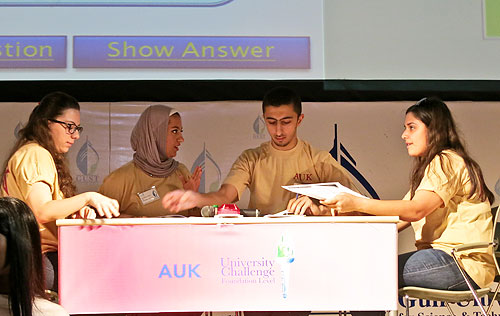
Ten American University of Kuwait (AUK) students departed Gulf University for Science and Technology (GUST) last Thursday with smiles on their faces - they had, after all, come in second place in the Math competition, and were the champions of the English competition. The first annual Foundation Level University Challenge was held at GUST on April 18, 2013, and participating institutes included the American University of Kuwait (AUK), the Australian College of Kuwait (ACK), Box Hill College (BHC), and the Gulf University for Science and Technology (GUST).
AUK came in second place for the Math competition with a score of 47, while ACK took the top spot with a score of 59, but this order was reversed when AUK's English team won with a landslide score of 102, while ACK came in second with 85. BHC and GUST came in third and fourth, respectively, for the English competition, and vice versa for the Math.
Within the University Challenge, there were four sections: the arithmetic section, the spelling bee, the algebra solve, and the sentence game. The sum of the scores for the arithmetic and algebra sections determined the winner of the Math competition, just as the sum of the spelling and sentence sections determined the winner of the English competition. Each university could have a team of five members - four participants and one alternate - for each portion of the game.
AUK's Math team, coached by Professor Monique Livsey of the Department of Mathematics and Natural Sciences, was composed of ten team members, while AUK's English team, coached by Professor Alison Larkin Koushki of the Intensive English Program (IEP), was composed of five team members. Livsey thanked the others who worked with the math team, saying, "I would like to acknowledge one person, Shoug Al-Othman, who was a critical member of our University Challenge Math Team. She served as a judge in the Math competition, and coached the Math 095 (Arithmetic) group." Livsey also praised her students for their outstanding work, saying, "I would just like to congratulate all the Math team members for their efforts and heartfelt commitment to success. I am proud of both the Math 095 and Math 100 teams, and look forward to working at a win for next year!" Koushki was similarly congratulatory, saying, "My team worked hard for weeks and never faltered in the slightest. What really impressed me was how they took the heat on the day of the event. With all eyes on them, they stayed calm and focused under pressure. IEP's really got talent." Clearly, the coaches were extremely pleased with their students' performances this year, and look forward to continuing their successes in the years to come.
Of the event, VIP attendee Rusty Bruns, Director of Information Technology, said, "It was a pleasure attending the University Challenge, and I was very proud of our students and how they performed. One first place and one second place finish - AMAZING. One could even make the case that it should have been two first place finishes. I was also so proud of how our students conducted themselves; they were extremely professional. They represented AUK very well."
Director of the Intensive English Program, Rebecca Sanchez-Loomis, had many congratulations to offer the students. She expressed her "congratulations to both the AUK English and Math teams," saying that, "they did an outstanding job competing for the first time in a new environment under time pressure." Sanchez-Loomis said she was very impressed with the Math team's comeback during the competition, and praised the "skilled guidance of Ms. Monique Livsey and her team of coaches" and that she knows that "the AUK Math team will take that trophy home from the next University Challenge."
Sanchez-Loomis also stated that she "expected nothing less than the hard work of Ms. Alison [Larkin] Koushki, whose tireless energy and enthusiasm, [combined] with the advanced skill of her selected team of IEP students and their coaches, kept our team ahead of the pack through most of the English competition." The support from the participants' fellow classmates and teachers "kept the excitement of the competition alive, and kept the judges in line when any mistakes were made," according to Sanchez-Loomis, concluding that, "overall, it was a proud day for AUK in its first University Challenge of the Foundation Programs sponsored by GUST."
The true celebrants of AUK's success, however, were the students that made it possible. Below is a list of the participants in this year's Foundation Level University Challenge:
Math team coach: Monique Livsey
Arithmetic Team: Mohammed Abdulsalam, Bashayer Al-Terkait, Farah Homaidan, Dana Jaber, Dan Al-Hassan
Algebra Team: Darin Kablaoui, Sara Lubbad, Nada Al-Kharashi, Zaid Al-Hadlaq, Shaimaa Kanderi
English team coach: Alison Larkin Koushki
English Team (both events): Marjan Ziaei Nafchi, Sarah Al-Shatri, Fatemah Al-Attar, Mariam Al-Wazzan, Haya Khaled Al-Rashed
Said the English team captain, Sarah Al-Shatri, after the event, "'Believing is the key to every success' - from the beginning, I believed that we would definitely win, so that motivated me to work even harder and to do my best." It seems like at least one of her teammates, Fatemah Al-Attar, was still stunned by the victory, saying, "I think that it was a great experience, and I've never won first place in anything before, so I still cannot believe that we won!"
But perhaps the person who best summed up the successes (Math and English) and feelings of the day was Mariam Al-Wazzan, another competitor, who said simply, "I just want to say that nothing is impossible, and you can always achieve whatever you want in life if you have passion, determination, and motivation."
Released by the Office of Public Affairs on the 24th April 2013
Photography by the Office of Public Affairs (C) 2013